
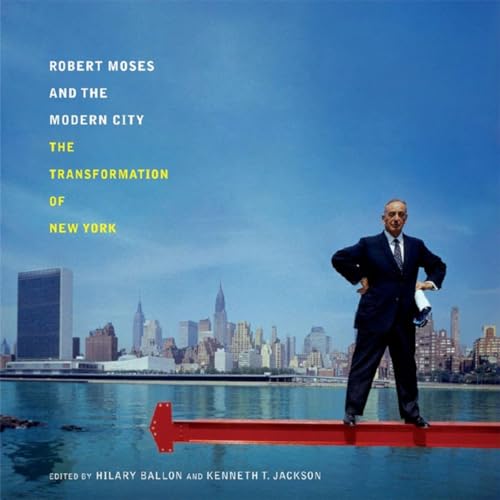
Robert Moses and the modern city : the transformation of New York / edited by Hilary Ballon and Kenneth T. Jackson.
Material type: TextLanguage: English Publication details: New York : W. W. Norton & Co., c2007.Edition: 1st edDescription: 336 pages : illustrations (some col.), maps, plans ; 26 cmContent type:
 - text
- unmediated
- volume
- 9780393732436 (paperback)
- 0393732436 (paperback)
- Moses, Robert, 1888-1981
- City planners -- New York (State) -- New York -- History -- 20th century -- Exhibitions
- Urbanistas -- Historia -- Nueva York (Estados Unidos) -- Siglo XX -- Exposiciones
- Municipal officials and employees -- New York (State) -- New York -- History -- 20th century -- Exhibitions
- Funcionarios y empleados municipales -- Nueva York (Estados Unidos)
- Public works -- New York (State) -- New York -- History -- 20th century -- Exhibitions
- Obras públicas -- Nueva York (Estados Unidos) -- Historia -- Siglo XX
- New York (N.Y.) -- History -- 20th century -- Exhibitions
- Nueva York (Estados Unidos) -- Historia -- Siglo XX
- 711/.4092
- NA 9085 R639 2007
| Item type | Current library | Home library | Collection | Shelving location | Call number | Copy number | Status | Barcode | |
|---|---|---|---|---|---|---|---|---|---|
 Libro
Libro
|
Biblioteca Juan Bosch | Biblioteca Juan Bosch | Humanidades | Humanidades (4to. Piso) | NA 9085 R639 2007 (Browse shelf(Opens below)) | 1 | Available | 00000193917 |
"This book is published in conjunction with the three-part exhibition 'Robert Moses and the modern city'"--T.p. verso.
Includes bibliographical references (pages 324-327) and index.
Robert Moses & the Modern City re-examines the life and work of Robert Moses, who dominated New York City urban planning and development from the 1930s to the 1960s. The book offers a balanced and richly illustrated perspective that goes beyond the polarized views of Moses as either a visionary builder or a destructive force.
The essays highlight Moses’s ambitious building programs, including vast park systems, iconic bridges, and extensive highways, which shaped the city’s modern infrastructure.
The book critically addresses the social consequences of Moses’s projects, such as the displacement of communities during urban renewal.
Through archival photographs and models, readers gain visual insight into Moses’s transformative impact and the scale of his work.
The editors and contributors provide a scholarly reassessment, situating Moses’s legacy within broader urban history and planning debates.
Overall, the book serves as both a tribute and a critique, reflecting the complexity of Moses’s influence on New York’s development.
There are no comments on this title.