
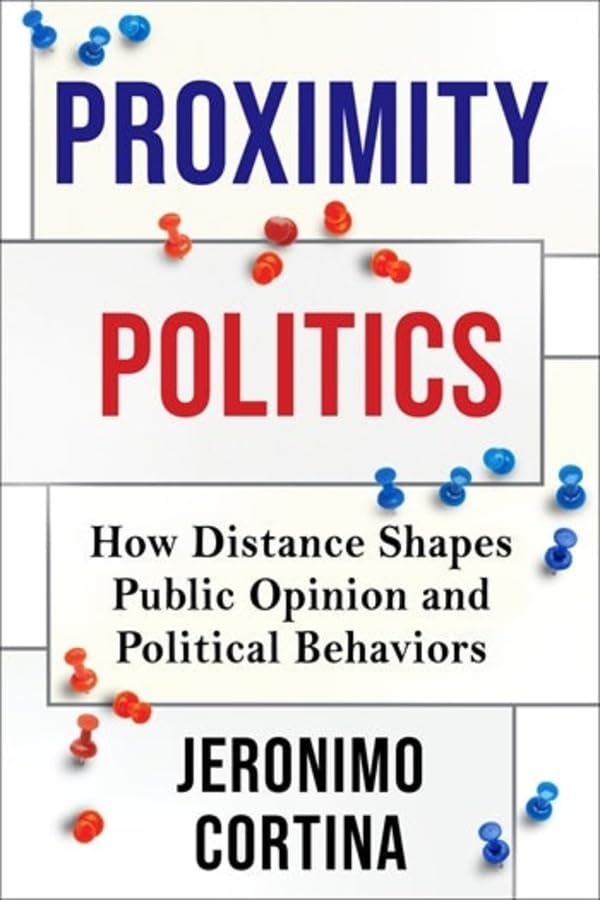
Proximity politics : how distance shapes public opinion and political behaviors / Jeronimo Cortina.
Material type: TextLanguage: English Publisher: New York : Columbia University Press, 2024Description: x, 248 pages : illustrations, maps ; 23 cmContent type:
 - text
- unmediated
- volume
- 9780231205337 (paperback)
- 0231205333 (paperback)
- 303.3/80973
- HN 90 C829p 2024
| Item type | Current library | Home library | Collection | Shelving location | Call number | Copy number | Status | Barcode | |
|---|---|---|---|---|---|---|---|---|---|
 Libro
Libro
|
Biblioteca Juan Bosch | Biblioteca Juan Bosch | Ciencias Sociales | Ciencias Sociales (3er. Piso) | HN 90 C829p 2024 (Browse shelf(Opens below)) | 1 | Available | 00000193997 |
Includes bibliographical references and index.
The forest and the trees -- Outbreaks, epidemics, and pandemics : Zika, Ebola, and COVID-19 -- Bombs and guns : Boston, Paris, and El Paso -- Protests : #BlackLivesMatter -- One-size does not fit all : attitudes toward immigration -- From a distance : partisanship, public attitudes, and geographic proximity toward the U.S.-Mexico border wall -- The perfect storm -- The great drought -- So what?
"In the aftermath of the Boston Marathon in April 2013, 66 percent of Americans thought a terrorist attack in the United States was likely to occur in the preceding months. Fast forward to 2015, days before the sentencing of the bomber, and American's worries of a terrorist attack on U.S. soil decreased by twenty-two points. Or consider the case of Ebola before and after it arrived in the United States. Before the CDC confirmed the first diagnosis in Dallas, Ebola did not even show up on the radar of public opinion. But once it landed in the Dallas Love Field airport, 17 percent of Americans ranked Ebola as one of the top three healthcare concerns. Why do people react differently to comparable events when one happens far away while the other happens at their doorstep? In Anxious Times, political scientist Jeronimo Cortina examines the role of geographic distance as a determinant of public attitudes. How does our proximity interact with the context in which we live, our partisan inclinations, our racial or ethnic identities, immigration status, and nationalities? By analyzing novel survey data, Cortina argues that geographic distance has two effects on public attitudes. First, as a catalyst for direct contact and, second, as a dynamic filter that shapes how people process information and understand a particular event, object, social group, or policy. In other words, the closer we are to an event, object, social group, or policy, the more we will care about it. This is why experiencing extreme weather events can change one's beliefs about the reality of climate change or why a Republican's support for a border wall increases the farther they are from it. The book takes a fresh look at Tobler's first law of geography ("everything is related to everything else, but near things are more related than distant things") for the formation of public attitudes and sheds light on these intricate connections."-- Provided by publisher.
There are no comments on this title.