
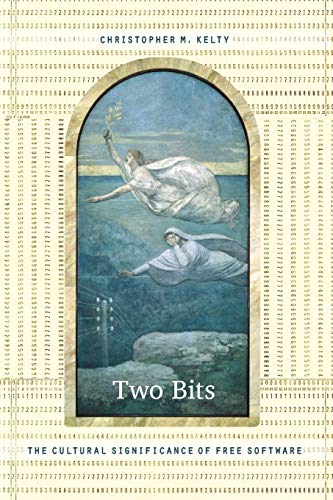
Two bits : the cultural significance of free software / Christopher M. Kelty.
Material type: TextLanguage: English Series: Experimental futuresPublication details: Durham, N.C. : Duke University Press, 2008.Description: xvi, 378 pages : illustrations ; 24 cmContent type:
 - text
- unmediated
- volume
- 9780822342649 (pbk. : alk. paper)
- 0822342642 (pbk. : alk. paper)
- 303.48/33
- HM 851 K29t 2008
| Item type | Current library | Home library | Collection | Shelving location | Call number | Copy number | Status | Barcode | |
|---|---|---|---|---|---|---|---|---|---|
 Libro
Libro
|
Biblioteca Juan Bosch | Biblioteca Juan Bosch | Ciencias Sociales | Ciencias Sociales (3er. Piso) | HM 851 K29t 2008 (Browse shelf(Opens below)) | 1 | Available | 00000190525 |
Includes bibliographical references (pages [349]-366) and index.
Geeks and recursive publics -- Protestant reformers, polymaths, transhumanists -- The movement -- Sharing source code -- Conceiving open systems -- Writing copyright licenses -- Coordinating collaborations -- "If we succeed, we will disappear" -- Reuse, modification, and the nonexistence of norms.
Investigates the history and cultural significance of Free Software. By exploring in detail how various practices came together as the Free Software movement from the 1970s to the 1990s, the author shows how it is possible to understand the new movements that are emerging out of Free Software: projects such as Creative Commons.
There are no comments on this title.