
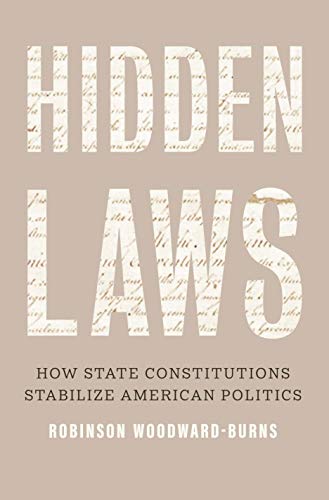
Hidden laws : how state constitutions stabilize American politics / Robinson Woodward-Burns.
Material type: TextLanguage: English Publisher: New Haven, Connecticut : Yale University Press, 2021Description: x, 355 pages : illustrations ; 24 cmContent type:
 - text
- unmediated
- volume
- 9780300248692 (pbk.)
- 0300248695 (pbk.)
- 342.73
- KF 4530 W912h 2021
| Item type | Current library | Home library | Collection | Shelving location | Call number | Copy number | Status | Barcode | |
|---|---|---|---|---|---|---|---|---|---|
 Libro
Libro
|
Biblioteca Juan Bosch | Biblioteca Juan Bosch | Ciencias Sociales | Ciencias Sociales (3er. Piso) | KF 4530 W912h 2021 (Browse shelf(Opens below)) | 1 | Available | 00000183719 |
Includes bibliographical references (pages 295-329) and index.
Rethinking American constitutional development -- First conventions, 1760-1791 -- Antebellum consensus, 1792-1849 -- State reconstruction, 1850-1877 -- Progressive experimentation, 1878-1931 -- Welfare states, 1932-1979 -- Contemporary constitutionalism, 1980-2020.
"The U.S. Constitution is remarkably stable. The world's first and oldest written national constitution, it has survived with little modification, facing only rare alteration by amendment or reinterpretation.State constitutions are much more fluid. The 144 different state constitutions ratified since 1776 have been amended thousands of times and are subject to relatively frequent judicial reinterpretation. Robinson Woodward-Burns argues that state constitutions' flexibility allows national constitutional and political stability. Using data sets and historical case studies of state and federal constitutional reform, he shows how the federal government has often relied on state constitutional change to manage or address difficult national constitutional controversies, including conflicts over the regulation of slavery, banking and taxation, women's suffrage, labor and welfare rights, voting and civil rights, and gender discrimination"-- Provided by publisher.
There are no comments on this title.