
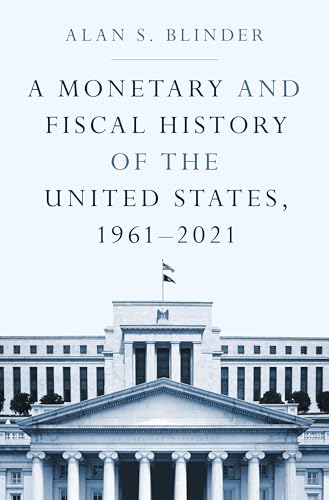
A monetary and fiscal history of the United States, 1961-2021 / Alan S. Blinder.
Material type: TextLanguage: English Publication details: Princeton, New Jersey : Princeton University Press, 2025.Edition: second paperback editionDescription: vi, 432 pages : illustrations (black and white) ; 21 cmISBN:
 - 9780691238401
- B648m 2025
| Item type | Current library | Home library | Collection | Shelving location | Call number | Copy number | Status | Barcode | |
|---|---|---|---|---|---|---|---|---|---|
 Libro
Libro
|
Biblioteca Juan Bosch | Biblioteca Juan Bosch | Automatización y Procesos Técnicos | Automatización y Procesos Técnicos (1er. Piso) | B648m 2025 (Browse shelf(Opens below)) | 1 | Available | 00000198055 |
Contenidos : Fiscal Policy on the New Frontier
Inflation and the Rise of Monetarism
The Phillips Curve Becomes Vertical
Nixon, Burns, and the Political Business Cycle
Stagflation and Its Aftermath
Inflation and the Rational Expectations Revolution
Carter, Volcker, and the Conquest of Inflation
Reaganomics and the Clash between Monetary and Fiscal Policy
The Long Expansion of the 1980s
Deficits Crowd Out Fiscal Policy, 1982–1998
The Long Boom of the 1990s
The 2000s: The Job‑Loss Recovery and the Bubbles
The Financial Crisis and the Great Recession
All Together Now: The Fed and the Treasury Join Hands
The Aftermath and the Backlash
The Record Expansion of the 2010s
Trumponomics before the Pandemic
Responding to the Great Pandemic
Sixty Years of Monetary and Fiscal Policy: What’s Changed? (conclusión / reflexión final)
Blinder’s book examines 60 years of U.S. monetary and fiscal policy, from 1961 to 2021, highlighting how government spending, taxation, and central bank actions shaped economic growth, inflation, and crises.
1960s: Fiscal policy was proactive, with tax cuts and spending used to stimulate growth.
1970s: Inflation rose sharply, leading to a monetarist approach where monetary policy gained prominence over fiscal stimulus.
1980s: Efforts by the Federal Reserve (Volcker) tamed inflation; Reaganomics showcased tensions between fiscal expansion and monetary restraint.
1990s: A long economic boom occurred with relatively low inflation and fiscal discipline.
2000s: Job-loss recoveries, housing bubbles, and the financial crisis of 2008 tested the interplay of monetary and fiscal policy.
2010s–2020s: Post-recession expansion, responses to pandemic-induced crises, and experiments with stimulus packages illustrated the limits and flexibility of U.S. economic policy.
Blinder emphasizes how monetary and fiscal policies sometimes cooperated and sometimes conflicted, shaped by political pressures, economic theories (Keynesianism, Monetarism, Rational Expectations), and external shocks. The book concludes with reflections on what has changed—and what has not—in U.S. macroeconomic policymaking over six decades.
There are no comments on this title.