
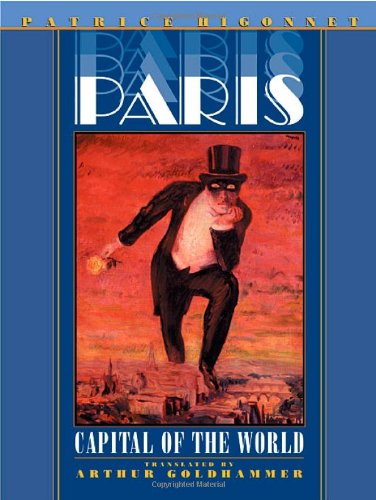
Paris, capital of the world / Patrice Higonnet ; translated by Arthur Goldhammer.
Material type: TextLanguage: English Original language: French Publication details: Cambridge, Mass. : Belknap Press of Harvard University Press, 2002.Description: 493 p., [32] p. of plates : ill. (some col.), maps (some col.) ; 26 cmISBN:
 - 0674008871 (alk. paper)
- Paris, capitale du monde. English
- 944.361
- 318 DC 707 H638p 2002
| Item type | Current library | Home library | Collection | Shelving location | Call number | Vol info | Copy number | Status | Barcode | |
|---|---|---|---|---|---|---|---|---|---|---|
 Libro
Libro
|
Biblioteca Juan Bosch | Biblioteca Juan Bosch | Recursos Regionales | Recursos Regionales (2do. Piso) | 318 DC 707 H638p 2002 (Browse shelf(Opens below)) | 1 | 1 | Available | 00000109806 |
Includes bibliographical references and index.
A city of myths -- Capital of the modern self -- Capital of revolution -- Mysterious capital of crime -- Negative myths of La Parisienne -- Capital of science -- Reading the Parisian myths -- The urban machine -- Capital of alienation -- Paris in the world -- Three literary visions -- Capital of pleasure -- The American imagination -- From myth to phantasmagoria -- The Surrealists' quest -- Capital of art -- A universal city.
"In a journey through modern Paris from the mid-eighteenth century to World War II, Patrice Higonnet offers a cultural portrait of a multifaceted, continually changing city. In examining the myths and countermyths of Paris that have been created and re-created over time, Higonnet reveals a magical urban alchemy in which each era absorbs the myths and perceptions of Paris past, adapts them to the cultural imperatives of its own time, and feeds them back into the city, creating a new environment." "Paris has been central to the modern world in ways internal and external, genuine and imagined, progressive and decadent. Higonnet explores Paris as the capital of revolution, science, empire, literature, and art, describing such incarnations as Belle Epoque Paris, the Commune, the Surrealists' city, and Paris as viewed through American eyes. He also evokes the more visceral Paris of alienation, crime, material excess, and sensual pleasure."--BOOK JACKET.
There are no comments on this title.