
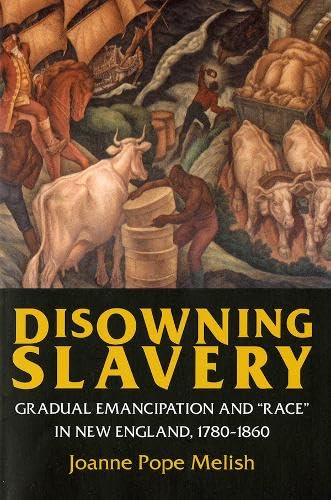
Disowning slavery : gradual emancipation and "race" in New England, 1780-1860 / Joanne Pope Melish.
Material type: TextPublication details: Ithaca : Cornell University Press, 1998.Description: xvii, 296 p. : ill. ; 25 cmISBN:
 - 0801434130 (acid-free paper)
- 9780801434136 (acid-free paper)
- 0801484375 (pbk. : acid-free paper)
- 9780801484377 (pbk. : acid-free paper)
- Antislavery movements -- New England -- History -- 18th century
- Antislavery movements -- New England -- History -- 19th century
- African Americans -- Civil rights -- New England -- History -- 18th century
- African Americans -- Civil rights -- New England -- History -- 19th century
- Slaves -- Emancipation -- New England -- History -- 18th century
- Slaves -- Emancipation -- New England -- History -- 19th century
- New England -- Race relations
- Slavernij
- Abolitionisme
- Vrijlating
- Rassenverhoudingen
- 326/.8/0974 21
- E445.N5 M523d 1998
- 15.85
| Item type | Current library | Home library | Collection | Shelving location | Call number | Copy number | Status | Barcode | |
|---|---|---|---|---|---|---|---|---|---|
 Libro
Libro
|
Biblioteca Juan Bosch | Biblioteca Juan Bosch | Automatización y Procesos Técnicos | Automatización y Procesos Técnicos (1er. Piso) | E445.N5 M523d 1998 (Browse shelf(Opens below)) | 1 | Available | 00000055060 |
Includes bibliographical references and index.
Publisher's description: Following the abolition of slavery in New England, white citizens seemed to forget that it had ever existed there. Drawing on a wide array of primary sources--from slaveowners' diaries to children's daybooks to racist broadsides--Joanne Pope Melish reveals not only how northern society changed but how its perceptions changed as well. Melish explores the origins of racial thinking and practices to show how ill-prepared the region was to accept a population of free people of color in its midst. Because emancipation was gradual, whites transferred prejudices shaped by slavery to their relations with free people of color, and their attitudes were buttressed by abolitionist rhetoric which seemed to promise riddance of slaves as much as slavery. She tells how whites came to blame the impoverished condition of people of color on their innate inferiority, how racialization became an important component of New England ante-bellum nationalism, and how former slaves actively participated in this discourse by emphasizing their African identity. Placing race at the center of New England history, Melish contends that slavery was important not only as a labor system but also as an institutionalized set of relations. The collective amnesia about local slavery's existence became a significant component of New England regional identity.
There are no comments on this title.