
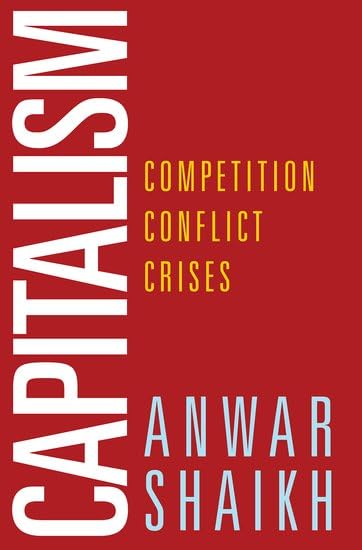
Capitalism : competition, conflict, crises / Anwar Shaikh.
Material type: TextLanguage: Spanish Publisher: Oxford ; New York, NY : Oxford University Press, [2016]Description: xxxv, 979 p. : ill. ; 25 cmContent type:
 - text
- unmediated
- volume
- 9780199390632 (hbk)
- 330.12 23
- HB 501 S526c 2016
| Item type | Current library | Home library | Collection | Shelving location | Call number | Copy number | Status | Barcode | |
|---|---|---|---|---|---|---|---|---|---|
 Libro
Libro
|
Biblioteca Juan Bosch | Biblioteca Juan Bosch | Ciencias Sociales | Automatización y Procesos Técnicos (1er. Piso) | HB 501 S526c 2016 (Browse shelf(Opens below)) | 1 | Available | 00000127430 |
Browsing Biblioteca Juan Bosch shelves, Shelving location: Automatización y Procesos Técnicos (1er. Piso), Collection: Ciencias Sociales Close shelf browser (Hides shelf browser)

|

|

|

|

|

|

|
||
| HB 171 G347a 2017 Progress and poverty / | HB 501 F911f 1980 Free to choose : a personal statement / | HB 501 M346i 2016 The information nexus : global capitalism from the Renaissance to the present / | HB 501 S526c 2016 Capitalism : competition, conflict, crises / | HB 846.8 S592b 2011 Beyond politics : the roots of government failure / | HC 79 T175d 1996 The digital economy : promise and peril in the age of networked intelligence / | HC 186.5 B333o 2011 O X da questao / |
Includes bibliographical references (pages 913-950) and indexes.
Neoclassical economical theory uses aspects of perfect functioning of markets as part of its basic assumptions and introduces imperfections as analysis proceeds forward. Many types of heterodox economics insist on dealing with imperfect competition but project backwards to a previous perfect state. In Capitalism, Anwar Shaikh demonstrates that most of the central propositions of economic analysis can be derived without any reference to hyperrationality, optimization, perfect competition, perfect information, representative agents or so-called rational expectations. These include the laws of demand and supply, the determination of wage and profit rates, technological change, relative prices, interest rates, bond and equity prices, exchange rates, terms and balance of trade, growth, unemployment, inflation, and long booms culminating in recurrent general crises. In every case, Shaikh's theory is applied to modern empirical patterns and contrasted with neoclassical, Keynesian, and Post Keynesian approaches to the same issues. The object of analysis is the economics of capitalism, and economic thought on the subject is addressed in that light. This is how the classical economists, as well as Keynes and Kalecki, approached the issue. Anyone interested in capitalism and economics in general can gain a wealth of knowledge from this ground-breaking text.
There are no comments on this title.