
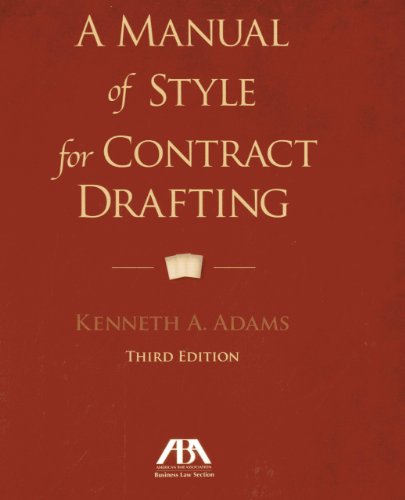
A manual of style for contract drafting / Kenneth A. Adams.
Material type: TextLanguage: English Publisher: Chicago, IL : American Bar Association, Business Law Section, [2013]Edition: 3rd editionDescription: xxxiv, 477 pages ; 26 cmContent type:
 - text
- unmediated
- volume
- 9781614388036 (spiral bound)
- 1614388032 (spiral bound)
- 808.06/634 23
- KF 807 A214m 2013
| Item type | Current library | Home library | Collection | Shelving location | Call number | Copy number | Status | Barcode | |
|---|---|---|---|---|---|---|---|---|---|
 Libro
Libro
|
Biblioteca Juan Bosch | Biblioteca Juan Bosch | Ciencias Sociales | Ciencias Sociales (3er. Piso) | KF 807 A214m 2013 (Browse shelf(Opens below)) | 1 | Available | 00000122583 |
Browsing Biblioteca Juan Bosch shelves, Shelving location: Ciencias Sociales (3er. Piso), Collection: Ciencias Sociales Close shelf browser (Hides shelf browser)

|

|

|

|

|

|

|
||
| KF 801 S464 2008 Selections for contracts : restatement second, ucc articles 1 and 2, uniform electronic transactions act, electronic signatures in global and national commerce act, UN sales convention, UNIDROIT principles, selected contracts and forms / | KF 801 T531d 2013 Developing professional skills : contracts / | KF 807 A214m 2004 A manual of style for contract drafting / | KF 807 A214m 2013 A manual of style for contract drafting / | KF 807 E77c 2010 Contract drafting : powerful prose in transactional practice / | KF836.Z9 F899 1981 Contract remedies in a nutshell / | KF 849 H434g 1990 Government contracting manual / |
Includes bibliographical references (page 457) and index.
The characteristics of optimal contract language -- The front of the contract -- Categories of contract language -- Layout -- The back of the contract -- Defined terms -- Sources of uncertainty in contract language -- "Reasonable efforts" and its variants -- "Material" and "material adverse change" -- References to time -- Ambiguity of the part versus the whole -- Syntactic ambiguity -- Selected usages -- Numbers and formulas -- Provisions specifying drafting conventions -- Typography -- Drafting as writing -- Amendments -- Letter agreements -- Drafting corporate resolutions.
A Manual of Style for Contract Drafting, Third Edition is a uniquely in-depth survey of the building blocks of contract language. First published in 2004, it offers those who draft, review, negotiate, or interpret contracts an alternative to the dysfunction of traditional contract language and the flawed conventional wisdom that perpetuates it. This manual has become a vital resource throughout the legal profession, in the U.S. and internationally.
This manual's focus remains how to express contract terms in prose that is free of the archaisms, redundancies, ambiguities, and other problems that afflict traditional contract language. With exceptional analysis and an unmatched level of practical detail, Adams highlights common sources of confusion and recommends clearer and more concise alternatives. This manual is organized to facilitate easy reference, and it illustrates its analysis with numerous examples. Consult it to save time in drafting and negotiation and to reduce the risk of dispute.
There are no comments on this title.