
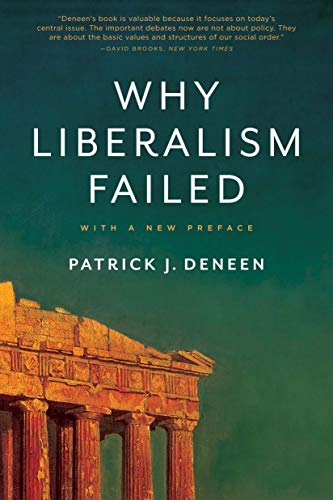
Why liberalism failed / Patrick J. Deneen ; foreword by James Davison Hunter and John M. Owen IV.
Material type: TextLanguage: English Publisher: New Haven : Yale University Press, 2019Description: xxxi, 225 pages ; 21 cmContent type:
 - text
- unmediated
- volume
- 9780300240023 (pbk.)
- 0300240023 (pbk.)
- JC 574 D392w 2019
| Item type | Current library | Home library | Collection | Shelving location | Call number | Copy number | Status | Barcode | |
|---|---|---|---|---|---|---|---|---|---|
 Libro
Libro
|
Biblioteca Juan Bosch | Biblioteca Juan Bosch | Ciencias Sociales | Ciencias Sociales (3er. Piso) | JC 574 D392w 2019 (Browse shelf(Opens below)) | 1 | Available | 00000136219 |
Browsing Biblioteca Juan Bosch shelves, Shelving location: Ciencias Sociales (3er. Piso), Collection: Ciencias Sociales Close shelf browser (Hides shelf browser)

|

|

|

|
No cover image available |

|

|
||
| JC 574 C647f 2010 Le frivole et le sérieux : vers un nouveau progressisme / | JC 574 C828d 1999 De la política de la libertad a la política de la igualdad : un ensayo sobre los límites del liberalismo / | JC 574 D392w 2018 Why liberalism failed / | JC 574 D392w 2019 Why liberalism failed / | JC 574 D488 2004 La devastación imperial del mundo / | JC 574 E56 2004 Encuentro de liberalismos / | JC 574 F278l 2014 Liberalism : the life of an idea / |
"With a new preface."--Cover
"Published with the assistance of the Institute for Advanced Studies in Culture, University of Virginia"--T.p. verso
Introduction:The end of liberalism --One. Unsustainable liberalism --Two. Uniting individualism and statism --Three. Liberalism as anticulture --Four. Technology and the loss of liberty --Five. Liberalism against liberal arts --Six. The new aristocracy --Seven. The degradation of citizenship --Conclusion:Liberty after liberalism.
"Of the three dominant ideologies of the twentieth century--fascism, communism, and liberalism--only the last remains. This has created a peculiar situation in which liberalism's proponents tend to forget that it is an ideology and not the natural end-state of human political evolution. As Patrick Deneen argues in this provocative book, liberalism is built on a foundation of contradictions: it trumpets equal rights while fostering incomparable material inequality; its legitimacy rests on consent, yet it discourages civic commitments in favor of privatism; and in its pursuit of individual autonomy, it has given rise to the most far-reaching, comprehensive state system in human history. Here, Deneen offers an astringent warning that the centripetal forces now at work on our political culture are not superficial flaws but inherent features of a system whose success is generating its own failure."
"Of the three dominant ideologies of the twentieth century--fascism, communism, and liberalism--only the last remains. This has created a peculiar situation in which liberalism's proponents tend to forget that it is an ideology and not the natural end-state of human political evolution. As Patrick Deneen argues in this provocative book, liberalism is built on a foundation of contradictions: it trumpets equal rights while fostering incomparable material inequality; its legitimacy rests on consent, yet it discourages civic commitments in favor of privatism; and in its pursuit of individual autonomy, it has given rise to the most far-reaching, comprehensive state system in human history. Here, Deneen offers an astringent warning that the centripetal forces now at work on our political culture are not superficial flaws but inherent features of a system whose success is generating its own failure."--Publisher's description.
There are no comments on this title.