
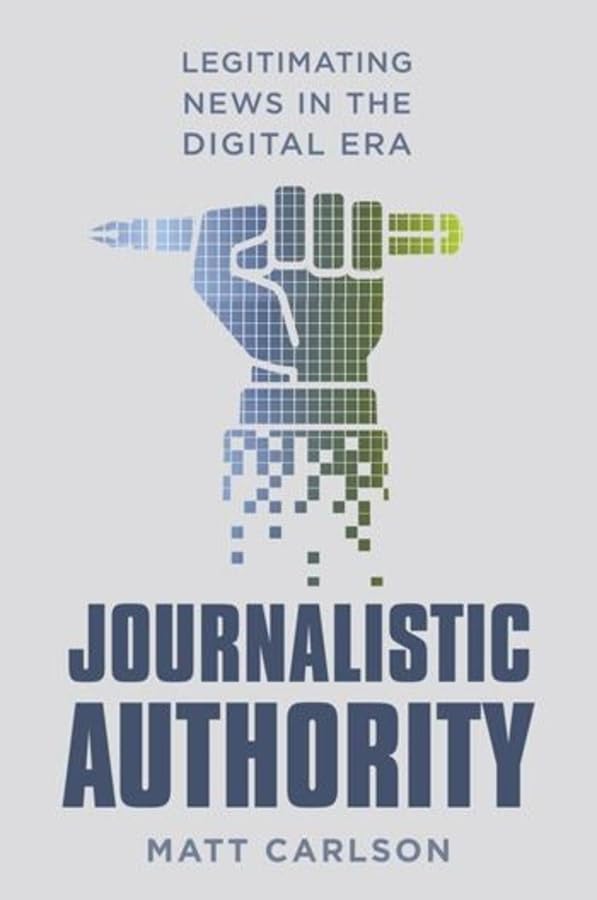
Journalistic authority : legitimating news in the digital era / Matt Carlson.
Language: eng Publication details: New York : Columbia University Press, 2017.Description: 248 p. ; 22 cmISBN:- 9780231174459
- PN 4888 C284j 2017
| Item type | Current library | Home library | Collection | Shelving location | Call number | Copy number | Status | Barcode | |
|---|---|---|---|---|---|---|---|---|---|
 Libro
Libro
|
Biblioteca Juan Bosch | Biblioteca Juan Bosch | Humanidades | Humanidades (4to. Piso) | PN 4888 C284j 2017 (Browse shelf(Opens below)) | 1 | Available | 00000152020 |
Browsing Biblioteca Juan Bosch shelves, Shelving location: Humanidades (4to. Piso), Collection: Humanidades Close shelf browser (Hides shelf browser)

|

|

|

|

|

|

|
||
| PN 4888 B864f 2012 The Fox effect : how Roger Ailes turned a network into a propaganda machine / | PN 4888 B993t 1998 Ted Turner : cable television tycoon / | PN 4888 C189s 1991 60 Minutes and the news : a mythology for Middle America / | PN 4888 C284j 2017 Journalistic authority : legitimating news in the digital era / | PN 4888 C396 2002 Censored 2003 : the top 25 censored stories / | PN 4888 C396 2007 Censored 2008 : the top 25 censored storiess / | PN 4888 C396 2008 Censored 2009 : the top 25 censored stories of 2008 / |
Introduction : the many relationships of journalism --
Foundations of journalistic authority. Professionalism as privilege and distance : journalistic identity ; Texts and textual authority : forms of journalism ; Telling stories about themselves : journalism's narratives --
Journalistic authority in context. Recognizing journalistic authority : the public's opinion ; Legitimating knowledge through knowers : news sources ; Mediating authority : the technologies of journalism ; Challenging journalistic authority : the role of media criticism --
Conclusion : the politics of journalistic authority.
When we encounter a news story, why do we accept its version of events? A complicated set of cultural, structural, and technological relationships inform this interaction, and Journalistic Authority provides a relational theory for explaining how journalists attain authority. The book argues that authority is not a thing to be possessed or lost, but a quality of the connections between those laying claim to being an authority and those who assent to it. Matt Carlson examines the practices journalists use to legitimate their work: professional orientation, development of specific news forms, and the personal narratives they circulate to support a privileged social place. He then considers journalists' relationships with the audiences, sources, technologies, and critics that shape journalistic authority in the contemporary media environment. Carlson argues that journalistic authority is always the product of complex and variable relationships. By creating a schema to account for this complexity, he presents a new model for critiquing journalism while advocating for the norms and practices we want to be authoritative.
There are no comments on this title.