
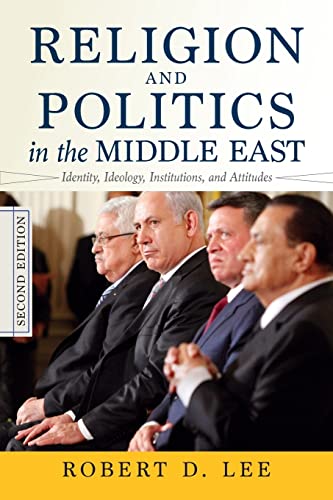
Religion and politics in the Middle East : identity, ideology, institutions, and attitudes / Robert D. Lee.
Material type: TextLanguage: English Publisher: Boulder : Westview Press, 2018Edition: 2nd editionDescription: xvi, 360 pages ; 23 cmContent type:
 - text
- unmediated
- volume
- 9780813348735 (pbk.)
- 0813348730 (pbk.)
- Religion and politics -- Middle East
- Religión y política -- Medio Oriente
- Islam and politics -- Middle East
- Islam y política
- Judaism and politics -- Middle East
- Judaísmo y política
- Group identity -- Middle East
- Political culture -- Middle East
- Religion and state -- Middle East
- Religión y estado
- Secularism -- Middle East
- Middle East -- Politics and government
- Medio oriente -- Política y gobierno
- 322/.10956
- BL 65 L479r 2014
| Item type | Current library | Home library | Collection | Shelving location | Call number | Copy number | Status | Barcode | |
|---|---|---|---|---|---|---|---|---|---|
 Libro
Libro
|
Biblioteca Juan Bosch | Biblioteca Juan Bosch | Humanidades | Humanidades (4to. Piso) | BL 65 L479r 2014 (Browse shelf(Opens below)) | 1 | Available | 00000164806 |
Browsing Biblioteca Juan Bosch shelves, Shelving location: Humanidades (4to. Piso), Collection: Humanidades Close shelf browser (Hides shelf browser)

|

|

|

|

|

|

|
||
| BL 65 J93t 2000 Terror in the mind of God : the global rise of religious violence / | BL 65 J93t 2001 Terrorismo religioso : El auge global de la violencia religiosa / | BL 65 L479r 2010 Religion and politics in the Middle East : identity, ideology, institutions, and attitudes / | BL 65 L479r 2014 Religion and politics in the Middle East : identity, ideology, institutions, and attitudes / | BL 65 L668t 1979 Le testament de Dieu / | BL 65 L827d 1994 Divination, mythology and monarchy in Han China / | BL 65 M231p 2011 El poder eclesiástico y el poder político ante el terrorismo de ETA / |
Includes bibliographical references and index.
Preface Acknowledgments Transliteration 1. The Political Determinants of Religion Historic Moments Nationalism in the Middle East Modernization Theory Identity Ideology Institutions Political Culture Religion as a Dependent Variable Conclusion 2. The Taming of Islam in Egypt Identity Ideology Institutions Political Culture Conclusion Chronology 3. The Transformation of Judaism in Israel Identity Ideology Institutions Political Culture Conclusion Chronology 4. The Politics of Religion in "Secularist" Turkey Identity Ideology Institutions Political Culture Outcomes Conclusion Chronology 5. State Shiism in Iran Identity Ideology Institutions Political Culture Conclusion Chronology 6. State Sunnism in Saudi Arabia Identity Ideology Institutions Political Culture Conclusion Chronology 7. Reconciling Religion and Politics Balance Identity Ideology Institutions Political Culture Conclusion Notes Glossary Bibliography Index
This innovative book analyzes the relationship between religion and politics in the Middle East through a comparative study of five countries---Egypt, Israel, Turkey, Iran, and Saudi Arabia. Robert D. Lee examines each country in terms of four domains in which state and religion necessarily interact: national identity, ideology, institutions, and political culture. In each domain he considers contradictory hypotheses, some of them asserting that religion is a positive force for political development and others identifying it as an obstacle. Among the questions the book confronts: Is secularization a necessary prerequisite for democratic development? How is it and why is it that religion and politics are so deeply entangled in these five countries? And, why is it that all five countries differ so markedly in the way they identify themselves and use religion for political purposes? The book argues that the nature of religious organization and practice in the Middle East must be understood in the context of individual nation states. The second edition is updated throughout and includes an entirely new chapter discussing the political and religious climate in Saudi Arabia. Earlier introductory analysis has been condensed to make room for new material, and chronologies at the end of each chapter have been added to help students understand the broader context. The second edition of Religion and Politics in the Middle East is a robust addition to courses on the Middle East.
There are no comments on this title.