
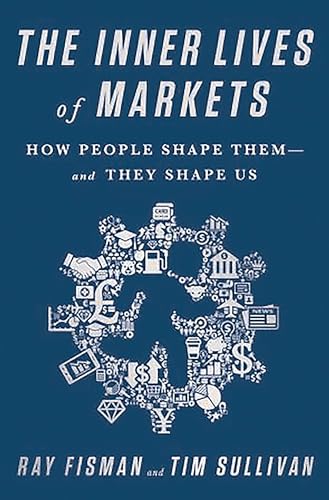
The inner lives of markets : how people shape them--and they shape us / Ray Fisman and Tim Sullivan.
Material type: TextLanguage: English Publisher: New York : PublicAffairs, [2016]Edition: First editionDescription: x, 206 pages ; 25 cmContent type:
 - text
- unmediated
- volume
- 9781610394925 (hardback)
- 1610394925 (hardback)
- 381
- HB 171 F542i 2016
| Item type | Current library | Home library | Collection | Shelving location | Call number | Copy number | Status | Barcode | |
|---|---|---|---|---|---|---|---|---|---|
 Libro
Libro
|
Biblioteca Juan Bosch | Biblioteca Juan Bosch | Ciencias Sociales | Ciencias Sociales (3er. Piso) | HB 171 F542i 2016 (Browse shelf(Opens below)) | 1 | Available | 00000165279 |
Browsing Biblioteca Juan Bosch shelves, Shelving location: Ciencias Sociales (3er. Piso), Collection: Ciencias Sociales Close shelf browser (Hides shelf browser)

|

|
No cover image available |

|

|

|
No cover image available | ||
| HB 171 E19 2005 Economía política del desarrollo / | HB 171 F252 1988 The fatal conceit : the errors of socialism (VOL.I) / | HB 171 F527t 1967 Teorías económicas burguesas del siglo XX / | HB 171 F542i 2016 The inner lives of markets : how people shape them--and they shape us / | HB171 .F911e 1987 The essence of Friedman / | HB 171 F911h 1996 | HB171 F911h 1996 Hidden order : the economics of everyday life / | HB 171 G148e 1972 Economía y subversión / |
Includes bibliographical references (pages 185-197) and index.
Introduction: Terms of service
Why people love markets : R.A. Radford's stiff upper lip and the economic organization of POW camps
The scientific aspirations of economists, and why they matter : how economics came to rule the world
How one bad lemon ruins the market : that's for me to know and for you to find out (but only when it's too late)
The power of signals in a world of cheap talk : face tattoos and other signs of hidden qualities
Building an auction for everything : the tale of the roller-skating economist
The economics of platforms : is that a market in your pocket or are you just happy to see me?
Markets without prices : how to find a prom date in seventeen easy steps
Letting markets work : how a hardcore socialist learned to stop worrying and love the market
How markets shape us : the making of King Rat
" What is a market? To most people it is a shopping center or an abstract space in which stock prices vary minutely. In reality, a market is something much more fundamental to being human, and it affects not just the price of tomatoes but the boundaries of everything we value. Reading the newspapers these days, you could be forgiven for thinking that markets are getting ever more efficient-and better. But as Tim Sullivan and Ray Fisman argue in this insightful book, that view is far from complete. For one thing, efficiency isn't always a good thing-illegal markets are very often more efficient than legal ones, because they are free of concern for laws and human rights. But even more importantly, the chatter about efficiency has obscured a much broader conversation about what kind of economic exchange we actually want. Every regulation, every sticker price, and every sale is part of an ever-changing ecosystem-one that affects us as much as we affect it. By tracing 50 years of economic thought on this subject, Fisman and Sullivan show how markets have evolved-and how we can keep making them better. This leads to fascinating and surprising insights, such as: Why your $10,000 used car is likely to sell for $2,000 or less; Why you should think twice before buying batteries on Amazon; and Why it's essential that healthy people buy medical insurance. In the end, The Inner Lives of Markets argues for a new way of thinking about how you spend your money-it shows that every transaction you make is part of a grand social experiment. We are all guinea pigs running through a lab maze, and the sooner we realize it, the more effectively we can navigate the path we want"-- Provided by publisher.
There are no comments on this title.