
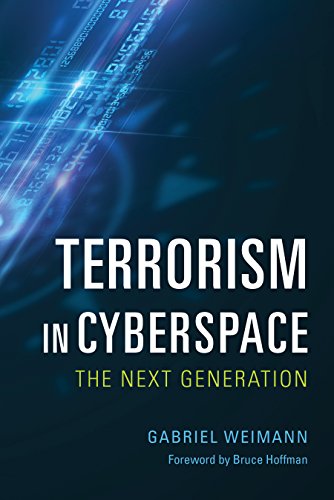
Terrorism in cyberspace : the next generation / Gabriel Weimann.
Material type: TextLanguage: English Publisher: Washington, D.C. ; New York : Columbia University Press : Woodrow Wilson Center Press ; [2015]Description: xvii, 296 pages : illustrations ; 23 cmContent type:
 - text
- unmediated
- volume
- 9780231704496 (paper)
- 0231704496 (paper)
- 9780231704489 (cloth)
- 0231704488 (cloth)
- 363.325
- HV 6773.15 W422t 2015
| Item type | Current library | Home library | Collection | Shelving location | Call number | Copy number | Status | Barcode | |
|---|---|---|---|---|---|---|---|---|---|
 Libro
Libro
|
Biblioteca Juan Bosch | Biblioteca Juan Bosch | Ciencias Sociales | Ciencias Sociales (3er. Piso) | HV 6773.15 W422t 2015 (Browse shelf(Opens below)) | 1 | Available | 00000165835 |
Browsing Biblioteca Juan Bosch shelves, Shelving location: Ciencias Sociales (3er. Piso), Collection: Ciencias Sociales Close shelf browser (Hides shelf browser)

|

|

|

|

|

|

|
||
| HV 6773.15 Q7c 2016 Ciberguerra / | HV 6773.15 S195p 2018 The perfect weapon : war, sabotage, and fear in the cyber age / | HV 6773.15 S195p 2019 The perfect weapon : war, sabotage, and fear in the cyber age / | HV 6773.15 W422t 2015 Terrorism in cyberspace : the next generation / | HV 6773.2 B838g 2013 Glass houses : privacy, secrecy, and cyber insecurity in a transparent world / | HV 6773.2 C599f 2020 The fifth domain : defending our country, our companies, and ourselves in the age of cyber threats / | HV 6773.2 P719a 1996 Anarchy online / |
Includes bibliographical references (pages 255-281) and index.
Terrorism enters cyberspace -- Narrowcasting -- Lone wolves in cyberspace -- The e-marketing of terror -- Debates online -- Online fatwas -- Terror on social media -- Cyberterrorism -- Countermeasures : noise and the M.U.D. model -- The war of narratives -- Challenging civil liberties.
The war on terrorism has not been won, Gabriel Weimann argues in Terrorism in Cyberspace, the successor to his seminal Terror on the Internet. Even though al-Qaeda's leadership has been largely destroyed and its organization disrupted, terrorist attacks take 12,000 lives annually worldwide, and jihadist terrorist ideology continues to spread. How? Largely by going online and adopting a new method of organization. Terrorist structures, traditionally consisting of loose-net cells, divisions, and subgroups, are ideally suited for flourishing on the Internet through websites, e-mail, chat rooms, e-groups, forums, virtual message boards, YouTube, Google Earth, and other outlets. Terrorist websites, including social media platforms, now number close to 10,000. This book addresses three major questions: why and how terrorism went online; what recent trends can be discerned--such as engaging children and women, promoting lone wolf attacks, and using social media; and what future threats can be expected, along with how they can be reduced or countered. To answer these questions, Terrorism in Cyberspace analyzes content from more than 9,800 terrorist websites, and Weimann, who has been studying terrorism online since 1998, selects the most important kinds of web activity, describes their background and history, and surveys their content in terms of kind and intensity, the groups and prominent individuals involved, and effects. He highlights cyberterrorism against financial, governmental, and engineering infrastructure; efforts to monitor, manipulate, and disrupt terrorists' online efforts; and threats to civil liberties posed by ill-directed efforts to suppress terrorists' online activities as future, worrisome trends.
There are no comments on this title.