
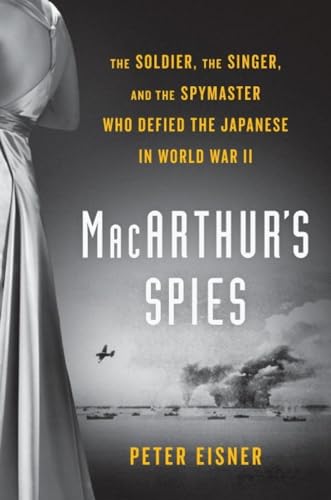
MacArthur's spies : the soldier, the singer, and the spymaster who defied the Japanese in World War II / Peter Eisner.
Material type: TextLanguage: English Publisher: New York : Viking, 2017Description: xv, 348 pages,16 unnumbered pages of plates : illustrations, maps ; 24 cmContent type:
 - text
- unmediated
- volume
- 9780525429654 (hardcover)
- 0525429654 (hardcover)
- Phillips, Claire, 1907-1960
- Parsons, Charles A., 1902-1988
- World War, 1939-1945 -- Secret service -- United States
- World War, 1939-1945 -- Secret service -- Philippines
- Guerra Mundial II, 1939-1945 -- Servicio secreto
- Spies -- Philippines -- Biography
- Spies -- United States -- Biography
- Espías -- Biografías
- Philippines -- History -- Japanese occupation, 1942-1945
- Filipinas -- Historia -- Ocupación japonesa, 1942-1945
- 940.54/8673
- D 810 E36m 2017
| Item type | Current library | Home library | Collection | Shelving location | Call number | Copy number | Status | Barcode | |
|---|---|---|---|---|---|---|---|---|---|
 Libro
Libro
|
Biblioteca Juan Bosch | Biblioteca Juan Bosch | Recursos Regionales | Recursos Regionales (2do. Piso) | D 810 E36m 2017 (Browse shelf(Opens below)) | 1 | Available | 00000165119 |
Browsing Biblioteca Juan Bosch shelves, Shelving location: Recursos Regionales (2do. Piso), Collection: Recursos Regionales Close shelf browser (Hides shelf browser)

|

|

|

|
No cover image available |

|

|
||
| D 810 C714s 2006 Secret intelligence and the Holocaust / | D810.C85 M36 2008 Krueger's men : the secret Nazi counterfeit plot and the prisoners of Block 19 / | D 810 E24m 2009 The monuments men/ alled heroes, nezi thieves, and the greatest treasure hunt in history | D 810 E36m 2017 MacArthur's spies : the soldier, the singer, and the spymaster who defied the Japanese in World War II / | D 810 F297c 1966 Como perros acosados / | D 810 F831h 2001 El hombre en busca de sentido / | D 810 F831h 2021 El hombre en busca de sentido / |
Includes bibliographical references and index.
The war -- Occupation -- Survival -- Fame -- Telling the story.
On January 2, 1942, Japanese troops marched into Manila unopposed by U.S. forces. Manila was a strategic port, a romantic American outpost and a jewel of a city. Tokyo saw its conquest of the Philippines as the key in its plan to control all of Asia, including Australia. Thousands of soldiers surrendered and were sent on the notorious eighty-mile Bataan Death March. But thousands of other Filipinos and Americans refused to surrender and hid in the Luzon hills above Bataan and Manila. MacArthur's Spies is the story of three of them, and how they successfully foiled the Japanese for more than two years, sabotaging Japanese efforts and preparing the way for MacArthur's return. From a jungle hideout, Colonel John Boone, an enlisted American soldier, led an insurgent force of Filipino fighters who infiltrated Manila as workers and servants to stage demolitions and attacks. "Chick" Parsons, an American businessman, polo player, and expatriate in Manila, was also a U.S. Navy intelligence officer. He escaped in the guise of a Panamanian diplomat, and returned as MacArthur's spymaster, coordinating the guerrilla efforts with the planned Allied invasion. And, finally, there was Claire Phillips, an itinerant American torch singer with many names and almost as many husbands. Her nightclub in Manila served as a cover for supplying food to Americans in the hills and to thousands of prisoners of war. She and the men and women who worked with her gathered information from the collaborating Filipino businessmen; the homesick, English-speaking Japanese officers; and the spies who mingled in the crowd
There are no comments on this title.