
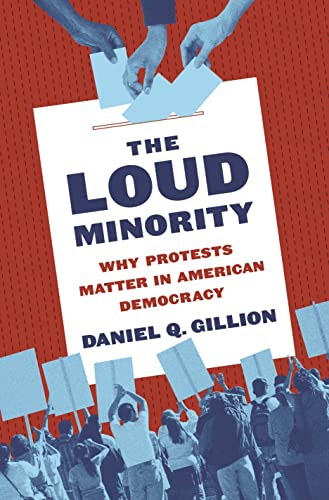
The loud minority : why protests matter in American democracy / Daniel Q. Gillion.
Material type: TextLanguage: English Series: Princeton studies in political behaviorPublisher: Princeton : Princeton University Press, 2020Description: viii, 212 pages : illustrations, maps, charts ; 24 cmContent type:
 - text
- unmediated
- volume
- 9780691181776 (hardcover ; alk. paper)
- 0691181772 (hardcover ; alk. paper)
- 322.40973
- HN 57 G481l 2020
| Item type | Current library | Home library | Collection | Shelving location | Call number | Copy number | Status | Barcode | |
|---|---|---|---|---|---|---|---|---|---|
 Libro
Libro
|
Biblioteca Juan Bosch | Biblioteca Juan Bosch | Ciencias Sociales | Ciencias Sociales (3er. Piso) | HN 57 G481l 2020 (Browse shelf(Opens below)) | 1 | Available | 00000163095 |
Browsing Biblioteca Juan Bosch shelves, Shelving location: Ciencias Sociales (3er. Piso), Collection: Ciencias Sociales Close shelf browser (Hides shelf browser)
| No cover image available |

|
No cover image available |

|
No cover image available |

|
No cover image available | ||
| HN 57 C719 1976 Colonial America : essays in politics and social development / | HN57 D273h 2000 A new history of social welfare / | HN57 F987t 1969 The Americans : Joseph Chamberlain a social history of the United States ; 1587-1914 / | HN 57 G481l 2020 The loud minority : why protests matter in American democracy / | HN 57 G982i 1966 The intitutional drive / | HN 57 J35r 2005 The reluctant welfare state : American social welfare policies--past, present, and future / | HN 57 L341a 1970 La agonía de la izquierda norteamericana / |
Includes bibliographical references (pages 195-207) and index.
1. Ideological Protests: The Protest Ties That Bind Us Together -- 2. The Making of Ideological Protests -- 3. Political Primaries: Protest's Ideological Connection at the Republican and Democratic National Conventions -- 4. Campaign Contributions: Following the Money to Find the Financial Benefits of Protest -- 5. Voter Turnout: Does Protest Lead to Voter Support or Public Backlash? The Case of Black Lives Matter -- 6. Election Results: A Protest Political Climate That Shapes Electoral Opportunities and Candidates' Fortunes -- Conclusion: A Change Is Gonna Come ... a Protest Change Is Always Gonna Come.
"The "silent majority"--A phrase coined by Richard Nixon in 1969 in response to Vietnam War protests and later used by Donald Trump as a campaign slogan - refers to the supposed wedge that exists between protesters in the street and the voters at home. The Loud Minority upends this view by demonstrating that voters are in fact directly informed and influenced by protest activism. Consequently, as protests grow in America, every facet of the electoral process is touched by this loud minority, benefiting the political party perceived to be the most supportive of the protesters' messaging. Drawing on historical evidence, statistical data, and detailed interviews about protest activity since the 1960s, Daniel Gillion shows that electoral districts with protest activity are more likely to see increased voter turnout at the polls. Surprisingly, protest activities are also moneymaking endeavors for electoral politics, as voters donate more to political candidates who share the ideological leanings of activists. Finally, protests are a signal of political problems, encouraging experienced political challengers to run for office and hurting incumbents' chances of winning reelection. The silent majority may not speak by protesting themselves, but they clearly gesture for social change with their votes. An exploration of how protests affect voter behavior and warn of future electoral changes, The Loud Minority looks at the many ways that activism can shape democracy." -- Publisher's description
There are no comments on this title.