
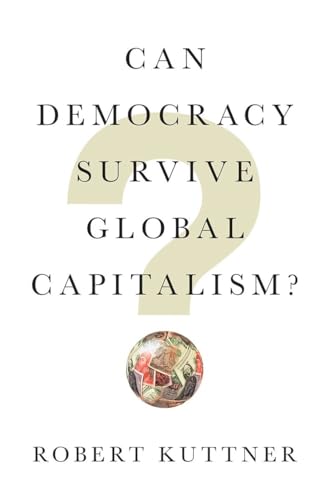
Can democracy survive global capitalism? / Robert Kuttner.
Material type: TextLanguage: English Publisher: New York : W. W. Norton & Company, 2018Edition: First editionDescription: xxii, 359 pages ; 25 cmContent type:
 - text
- unmediated
- volume
- 9780393609936 (hardcover)
- 0393609936
- 320.9182/1 23
- HD 87 K97c 2018
| Item type | Current library | Home library | Collection | Shelving location | Call number | Copy number | Status | Barcode | |
|---|---|---|---|---|---|---|---|---|---|
 Libro
Libro
|
Biblioteca Juan Bosch | Biblioteca Juan Bosch | Ciencias Sociales | Ciencias Sociales (3er. Piso) | HD 87 K97c 2018 (Browse shelf(Opens below)) | 1 | Available | 00000169879 |
Browsing Biblioteca Juan Bosch shelves, Shelving location: Ciencias Sociales (3er. Piso), Collection: Ciencias Sociales Close shelf browser (Hides shelf browser)

|

|

|

|

|

|

|
||
| HD 87 I61 1991 International volatility and economic growth : the first ten years of the International Seminar on Macroeconomics / | HD 87 K26c 2017 Can we avoid another financial crisis? / | HD 87 K26p 2021 ¿Podemos evitar otra crisis financiera? / | HD 87 K97c 2018 Can democracy survive global capitalism? / | HD 87 L265g 2002 Government and the economy : a global perspective / | HD 87 L392n 1999 Neoconservadorismo versus capitalismo competitivo / | HD 87 L438 2013 Learning from the World : New Ideas to Redevelop America / |
Includes bibliographical references (pages 315-344) and index.
A song of angry men -- A vulnerable miracle -- The rise and fall of democratic globalism -- The liberation of finance -- The global assault on labor -- Europe's broken social contract -- The disgrace of the center left -- Trading away a decent economy -- Taxes and the corporate state -- Governing global capitalism -- Liberalism, populism, fascism -- The road from here.
"'Democracies govern nations, while global capitalism runs the world. Robert Kuttner provides a clear-eyed, intellectually riveting account of how the inevitable tensions between the two have fueled neofascist nationalism here and abroad, and why the response must be a new progressive populism rooted in democracy and social justice. Timely and compelling.'--Robert B. Reich. In the past few decades, the wages of most workers have stagnated, even as productivity increased. Social supports have been cut, while corporations have achieved record profits. Downward mobility has produced political backlash. What is going on? [This book] argues that neither trade nor immigration nor technological change is responsible for the harm to workers' prospects. According to Robert Kuttner, global capitalism is to blame. By limiting workers' rights, liberating bankers, allowing corporations to evade taxation, and preventing nations from ensuring economic security, raw capitalism strikes at the very foundation of a healthy democracy. The resurgence of predatory capitalism was not inevitable. After the Great Depression, the U.S. government harnessed capitalism to democracy. Under Roosevelt's New Deal, labor unions were legalized and capital regulated. Well into the 1950s and '60s, the Western world combined a thriving economy with a secure and growing middle class. Beginning in the 1970s, as deregulated capitalism regained the upper hand, elites began to dominate politics once again; policy reversals followed. The inequality and instability that ensued would eventually, in 2016, cause disillusioned voters to support far-right faux populism. Is today's poisonous alliance of reckless finance and ultra-nationalism inevitable? Or can we find the political will to make capitalism serve democracy, and not the other way around? Charting a plan for bold action based on political precedent, [this book] is essential reading for anyone eager to reverse the decline of democracy in the West."--Jacket.
There are no comments on this title.