
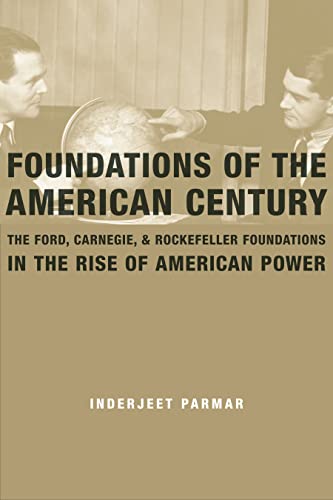
Foundations of the American century : the Ford, Carnegie, and Rockefeller Foundations in the rise of American power / Inderjeet Parmar.
Material type: TextLanguage: English Publication details: New York : Columbia University Press, 2014.Description: xv, 356 pages ; 23 cmContent type:
 - text
- computer
- online resource
- 9780231146296 (pbk. : alk. paper)
- 0231146299 (pbk. : alk. paper)
- Carnegie Foundation for the Advancement of Teaching -- History
- Ford Foundation -- History
- Rockefeller Foundation -- History
- Fundación Carnegie para el Avance de la Enseñanza -- Historia
- Fundación Ford -- Historia
- Fundación Rockefeller -- Historia
- International relations
- Relaciones internacionales
- United States -- Foreign relations -- 20th century
- Estados unidos -- Relaciones Internacionales -- Siglo XX
- 327.7300904
- HV 97 P253f 2014
- Issued also in print.
| Item type | Current library | Home library | Collection | Shelving location | Call number | Copy number | Status | Barcode | |
|---|---|---|---|---|---|---|---|---|---|
 Libro
Libro
|
Biblioteca Juan Bosch | Biblioteca Juan Bosch | Ciencias Sociales | Ciencias Sociales (3er. Piso) | HV 97 P253f 2014 (Browse shelf(Opens below)) | 1 | Available | 00000169987 |
Includes bibliographical references and index.
Frontmatter -- Contents -- Preface to the Paperback Edition -- Acknowledgments -- 1. The Significance of Foundations in U.S. Foreign Policy -- 2. American Foundation Leaders -- 3. Laying the Foundations of Globalism, 1930-1945 -- 4. Promoting Americanism, Combating Anti-Americanism, and Developing a Cold War American Studies Network -- 5. The Ford Foundation in Indonesia and the Asian Studies Network -- 6. Ford, Rockefeller, and Carnegie in Nigeria and the African Studies Network -- 7. The Major Foundations, Latin American Studies, and Chile in the Cold War -- 8. American Power and the Major Foundations in the Post-Cold War Era.
Inderjeet Parmar reveals the complex interrelations, shared mindsets, and collaborative efforts of influential public and private organizations in the building of American hegemony. Focusing on the involvement of the Ford, Rockefeller, and Carnegie foundations in U.S. foreign affairs, Parmar traces the transformation of America from an "isolationist" nation into the world's only superpower, all in the name of benevolent stewardship.Parmar begins in the 1920s with the establishment of these foundations and their system of top-down, elitist, scientific giving, which focused more on managing social, political, and economic change than on solving modern society's structural problems. Consulting rare documents and other archival materials, he recounts how the American intellectuals, academics, and policy makers affiliated with these organizations institutionalized such elitism, which then bled into the machinery of U.S. foreign policy and became regarded as the essence of modernity. America hoped to replace Britain in the role of global hegemon and created the necessary political, ideological, military, and institutional capacity to do so, yet far from being objective, the Ford, Rockefeller, and Carnegie foundations often advanced U.S. interests at the expense of other nations. Incorporating case studies of American philanthropy in Nigeria, Chile, and Indonesia, Parmar boldly exposes the knowledge networks underwriting American dominance in the twentieth century.
Issued also in print.
English
There are no comments on this title.