
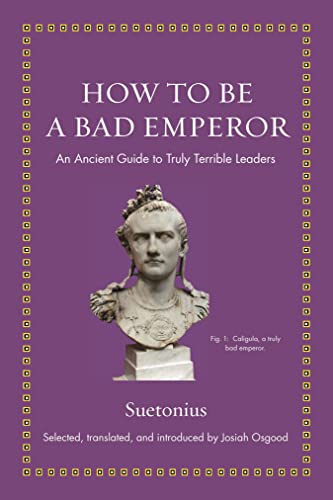
How to be a bad emperor : an ancient guide to truly terrible leaders / Suetonius ; selected, translated, and introduced by Josiah Osgood.
Material type: TextLanguage: English, Latin Original language: Latin Series: Ancient wisdom for modern readersPublication details: Princeton : Princeton University Press, 2020.Description: xxi, 288 pages ; 18 cmContent type:
 - text
- computer
- online resource
- 9780691193991
- 0691193991
- 937
- 324 DG 277 S944h 2020
| Item type | Current library | Home library | Collection | Shelving location | Call number | Copy number | Status | Barcode | |
|---|---|---|---|---|---|---|---|---|---|
 Libro
Libro
|
Biblioteca Juan Bosch | Biblioteca Juan Bosch | Recursos Regionales | Recursos Regionales (2do. Piso) | 324 DG 277 S944h 2020 (Browse shelf(Opens below)) | 1 | Available | 00000170845 |
Browsing Biblioteca Juan Bosch shelves, Shelving location: Recursos Regionales (2do. Piso), Collection: Recursos Regionales Close shelf browser (Hides shelf browser)

|

|

|

|

|

|
No cover image available | ||
| 002 E 178 A969c 2006 The complete idiot's guide to American history / | 118 PQ 7409.2 B428d 2016 Del aborto a la presidencia / | 118 LB 41 A448h 2023 Hallazgos de la neuroeducación para el aprendizaje temprano : Se trata además de inclusión social y cambio de época / | 324 DG 277 S944h 2020 How to be a bad emperor : an ancient guide to truly terrible leaders / | 400 DS 520 V953a 2011 L'ASEAN de A à Z : (Histoire, Géopolitique, Concepts, Personnages) / | 324 DG 737.42 H162f 2001 Florence and the Medici / | 118 RA 456 S181 1982 Salud pública : cuatro años de gobierno, 1978-1982 / |
Includes bibliographical references (pages 285-288) and index.
Introduction -- Ignore bad omens . . . and your wife: Julius Caesar (100-44 B.C.) -- Spend all your time at your resort: Tiberius (42 B.C.-A.D. 37) -- Make your horse a consul: Gaius Caligula (A.D. 12-41) -- Fiddle while Rome burns: Nero (A.D. 37-64)
"Gaius Suetonius Tranquillus was secretary of correspondence for the emperor Hadrian and author of the multi-part biography, Lives of the Caesars. A landmark in the development of realistic biography-writing, this work gives an account of twelve emperors, beginning with Julius Caesar. In each biography, Suetonius moves beyond the great events of Roman history and sets out to reveal the small and telling details of his subjects' lives. Suetonius' zeal in accumulating and relating what may appear to be trivial has sometimes led to the charge that he was little better than a gossip. Yet he was interested in deeper questions that fascinate political observers today. It is Suetonius' view that emperors ultimately had the power to achieve much both for good and for ill. Augustus beautified Rome, improved its infrastructure, restored its religion, and promoted discipline in the army. But other emperors, such as Tiberius, Caligula, and Nero, infamously used their power to indulge vice and harm others. Ever since their publication, Suetonius' imperial biographies have appealed to readers, both because of their sensational stories and the larger questions of power they raise. They spawned many sequels in antiquity (as well as more recent works like Robert Graves's famed, I, Claudius). While a number of good English translations are in print, reading Lives of the Caesar from cover to cover can be daunting, so many details are included. Also general readers, including students, are really interested in the stories of the bad emperors. This book, then, in a reversal of the usual self-help formula that Suetonius would appreciate, offers selections from the lives of four bad emperors (Julius Caesar, Tiberius, Caligula, and Nero) to create a guide on how to be a bad leader. own worst qualities and become more dangerous to us than any enemy. Osgood will start the volume with an introduction to Suetonius and his biographies, and also include introductions and (as appropriate, epilogues) to the individual selections. These will offer a reader already acquainted with Suetonius a better sense of the biographer's achievement and value as well as some ideas on why autocrats, or would-be autocrats, have always proven a rich subject for biographers"-- Provided by publisher.
In English and Latin.
Description based on print version record and CIP data provided by publisher.
There are no comments on this title.