
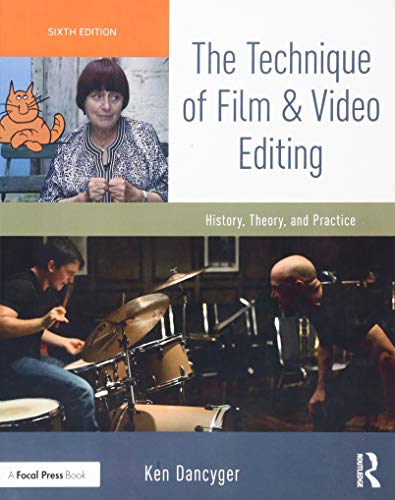
The technique of film and video editing : history, theory, and practice / Ken Dancyger.
Material type: TextLanguage: English Publication details: New York, NY : Routledge, 2019.Edition: 6th editionDescription: xxv, 511 pages : illustrations ; 24 cmISBN:
 - 9781138628403 (pbk. : alk. paper)
- 1138628409 (pbk. : alk. paper)
- 778.5/235
- TR 899 D175t 2019
| Item type | Current library | Home library | Collection | Shelving location | Call number | Copy number | Status | Barcode | |
|---|---|---|---|---|---|---|---|---|---|
 Libro
Libro
|
Biblioteca Juan Bosch | Biblioteca Juan Bosch | Humanidades | Humanidades (4to. Piso) | TR 899 D175t 2019 (Browse shelf(Opens below)) | 1 | Available | 00000170131 |
"A Focal Press book"--Cover
Includes bibliographical references (p. 458-460) and index.
Includes filmography: p. 435-448.
Introduction
Section 1. History of film editing. The silent period
The early sound film
The influence of the documentary
The influence of the popular arts
The influence of other arts
Editors who became directors
Experiments in editing : Alfred Hitchcock
Experiments in editing II : Robert Altman
New technologies
International advance
The influence of television and theatre
New challenges to filmic narrative conventions
The MTV influence on editing I
The MTV influence on editing II
Changes in pace
The appropriation of style I : imitation and innovation
The appropriation of style II : limitation and innovation
The appropriation of style III : digital reality
Section 2. Goals of editing. Editing for narrative clarity
Editing for dramatic emphasis
Editing for subtext
Editing for surprise
Editing for aesthetics
Section 3. Editing for the genre. Action
Dialog
Comedy
Documentary
Imaginative documentary
Innovation in documentary I
Innovations in documentary II
Innovation in documentary III : the experimental documentary
Section 4. Principles of editing. The picture edit and continuity
The picture edit and pace
Ideas and sound
The sound edit and clarity
The sound edit and creative sound
Innovations of sound
Nonlinear editing and digital technology I
Nonlinear editing and digital technology II
Conclusion
This updated sixth edition of The Technique of Film and Video Editing provides a detailed, precise look at the artistic and aesthetic principles and practices of editing for both picture and sound. Ken Dancyger puts into context the storytelling choices an editor will have to make against a background of theory, history, and practice across a range of genres, including action, comedy, drama, documentary and experimental forms, featuring analysis of dozens of classic and contemporary films. This new sixth edition includes new chapters on the influence of other media on the editing form, on the importance of surprise in editing, on the contributions of Robert Altman to the art of editing and on the experimental documentary. This edition also includes expanded coverage in technology, creative sound, point of view, and the long take. New case studies explore Whiplash (2014), Room (2015), Lincoln (2012), Tangerine (2015), The Beaches of Agnès (2008), American Sniper (2014), Son of Saul (2015), The Revenant (2015), and many more
There are no comments on this title.