
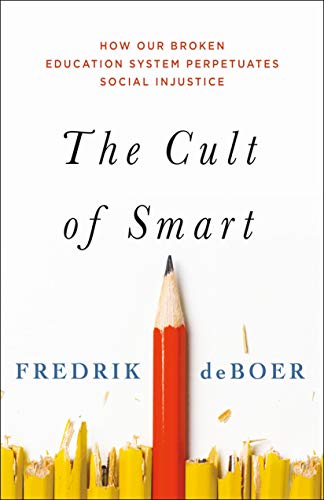
The cult of smart : how our broken education system perpetuates social injustice / Fredrik deBoer.
Material type: TextLanguage: English Publisher: New York : All Points Books, an imprint of St. Martin's Publishing Group, 2020Edition: First editionDescription: 276 pages ; 22 cmContent type:
 - text
- unmediated
- volume
- 9781250200372 (hardcover)
- 1250200377 (hardcover)
- Education -- Aims and objectives -- United States
- Educación -- Fines y objetivos -- Estados Unidos
- Intelligence levels -- Social aspects -- United States
- Cociente intelectual -- Aspectos sociales -- Estados Unidos
- Educational change -- United States
- Cambio educativo -- Estados Unidos
- Educational equalization -- United States
- Calidad de la educación -- Estados Unidos
- Social justice -- United States
- Justicia social -- Estados Unidos
- 370.110973
- LA 217.2 D287c 2020
| Item type | Current library | Home library | Collection | Shelving location | Call number | Copy number | Status | Barcode | |
|---|---|---|---|---|---|---|---|---|---|
 Libro
Libro
|
Biblioteca Juan Bosch | Biblioteca Juan Bosch | Humanidades | Humanidades (4to. Piso) | LA 217.2 D287c 2020 (Browse shelf(Opens below)) | 1 | Available | 00000173648 |
Browsing Biblioteca Juan Bosch shelves, Shelving location: Humanidades (4to. Piso), Collection: Humanidades Close shelf browser (Hides shelf browser)


Includes bibliographical references and index.
Introduction
To the victors goes everything
The god that fails
Equality of opportunity, liberalism's great lie
Schools, where the talent gap has teeth
Does school quality matter? Not really
The whims of nature
Before the veil of ignorance
Realistic reforms
A world to win
Epilogue
"In order to move toward a more egalitarian society, the American education system must be reformed to account for genetic differences between individual academic abilities. All groups, all races, and all genders are created equal. Not all individuals are. The Cult of Smart is a provocative and groundbreaking discussion of human potential, a topic which, in recent times, has been corrupted by the pernicious and cynical pseudoscience of "race realism." Fredrik deBoer-an expert on testing and assessment who has spent as much time in a classroom as he as in the library-takes on intelligence and inequality from the unorthodox perspective of progressive politics. He makes the case that intelligence exists, matters, and is diverse, and that this diversity of potential should be embraced by all who hope for a more egalitarian society. Our education system, our expectations for students, and our fundamental values as a liberal society are based on the idea that every seed can ultimately produce equal fruit. This premise is pretty, but it denies science and reality and misplaces our values: we shouldn't cultivate our children in the first place. We should help them grow. To be fairer, more equal, and more progressive, we must embrace subjects that our politics have unnecessarily made uncomfortable. This book may sting at first, but its ultimate message is one of profound humanity and optimism: we aren't all equal in every way. It isn't incumbent on us to treat one another equally because we earn it; we must treat each other equally because it is the right thing to do. Let's tend to the soil"-- Provided by publisher.
There are no comments on this title.