
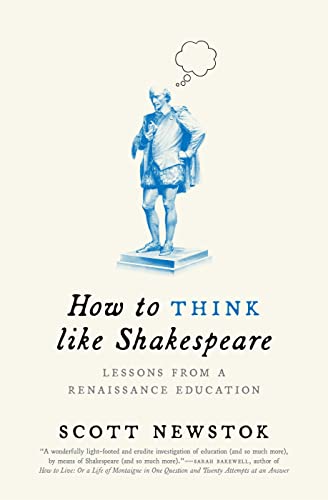
How to think like Shakespeare : lessons from a renaissance education / Scott Newstok.
Material type: TextLanguage: English Publisher: Princeton : Princeton University Press, 2021Description: xv, 185 pages : illustrations ; 23 cmContent type:
 - text
- unmediated
- volume
- 9780691227696
- 0691227691
- 370.11/2
- LB 1590.3 N558h 2021
| Item type | Current library | Home library | Collection | Shelving location | Call number | Copy number | Status | Barcode | |
|---|---|---|---|---|---|---|---|---|---|
 Libro
Libro
|
Biblioteca Juan Bosch | Biblioteca Juan Bosch | Humanidades | Humanidades (4to. Piso) | LB 1590.3 N558h 2021 (Browse shelf(Opens below)) | 1 | Available | 00000175680 |
Includes bibliographical references and index.
Of thinking -- Of ends -- Of craft -- Of fit -- Of place -- Of attention -- Of technology -- Of imitation -- Of exercise -- Of conversation -- Of stock -- Of constraint -- Of making -- Of freedom.
"This book offers a short, spirited defense of rhetoric and the liberal arts as catalysts for precision, invention, and empathy in today's world. The author, a professor of Shakespeare studies at a liberal arts college and a parent of school-age children, argues that high-stakes testing and a culture of assessment have altered how and what students are taught, as courses across the arts, humanities, and sciences increasingly are set aside to make room for joyless, mechanical reading and math instruction. Students have been robbed of a complete education, their imaginations stunted by this myopic focus on bare literacy and numeracy. Education is about thinking, Newstok argues, rather than the mastery of a set of rigidly defined skills, and the seemingly rigid pedagogy of the English Renaissance produced some of the most compelling and influential examples of liberated thinking. Each of the fourteen chapters explores an essential element of Shakespeare's world and work, aligns it with the ideas of other thinkers and writers in modern times, and suggests opportunities for further reading. Chapters on craft, technology, attention, freedom, and related topics combine past and present ideas about education to build a case for the value of the past, the pleasure of thinking, and the limitations of modern educational practices and prejudices"-- Provided by publisher.
There are no comments on this title.