
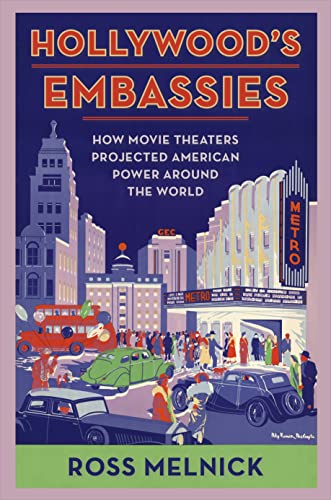
Hollywood's embassies : how movie theaters projected American power around the world / Ross Melnick.
Material type: TextLanguage: English Series: Film and culture | Film and culture seriesPublisher: New York, NY : Columbia University Press, 2022Description: xv, 503 pages : illustrations ; 24 cmContent type:
 - text
- still image
- unmediated
- volume
- 9780231201513 (trade paperback)
- 0231201516 (trade paperback)
- 725.823
- NA 6845 M527h 2022
| Item type | Current library | Home library | Collection | Shelving location | Call number | Copy number | Status | Barcode | |
|---|---|---|---|---|---|---|---|---|---|
 Libro
Libro
|
Biblioteca Juan Bosch | Biblioteca Juan Bosch | Humanidades | Humanidades (4to. Piso) | NA 6845 M527h 2022 (Browse shelf(Opens below)) | 1 | Available | 00000177512 |
Browsing Biblioteca Juan Bosch shelves, Shelving location: Humanidades (4to. Piso), Collection: Humanidades Close shelf browser (Hides shelf browser)

|

|

|

|

|

|

|
||
| NA 6813 P742c 2002 Centre Georges Pompidou París / | NA 6830 M878t 2006 Theaters / | NA 6840 D273t 1997 This wooden "O" : Shakespeare's Globe reborn / | NA 6845 M527h 2022 Hollywood's embassies : how movie theaters projected American power around the world / | NA 6846 S211c 2018 Cines de Madrid / | NA 6846 S211c 2022 Cines de barrio / | NA 7110 H842 2004 The house book. |
Includes bibliographical references and index.
Introduction: "Shop Windows," "Cultural Embassies," and Hollywood's Global Exhibition
Part 1. Europe. When Expansion Was Paramount (1923-1993): "Shop Window" Cinemas and the European Expansion of U.S. Film Exhibitors
1. Hollywood's British Invasion and the Battle of Birmingham, 1919-1929
2. Hollywood's European Adventure, 1925-1941
3. A New Battleground: U.S. Exhibitors Under Nazi Occupation, 1941-1945
4. Postwar Europe and the Legacy of Hollywood Cinemas, 1945-1993
Part 2. Australasia. Banking on Australasia (1930-1982): Global Banks and U.S. Cinema Ownership in Australia and New Zealand
5. Fox Chases Hoyts: U.S. Cinema Ownership in Australia, 1930-1936
6. The Fox Chase in New Zealand and Australia, 1936-1946
7. Hollywood and Australasian Cinemas, 1946-1982
Part 3: Latin America and the Caribbean. Hollywood in Cinelandia (1927-1973): U.S. Cinemas and Local Politics in Latin America and the Caribbean
8. Cine Metros y Cine Paramounts, 1926-1941: MGM and Paramount's Latin American Shop Window Cinemas
9. Prop(aganda) Window Cinemas, 1933-1945: Ufa, Hollywood, and the Battle for Hearts and Minds Through South American Cinemas Durgaing World War II
10. Hollywood Cinema Expansion in Postwar South America, 1945-1973
11. Caribbean Dreams, 1929-1973: Hollywood Cinemas in Cuba, Jamaica, Puerto Rico, and Trinidad
Part 4. Middle East. Hollywood's Muddle East (1925-1982): Political Change in Egypt and Israel and the Consequences for Hollywood's Middle Eastern Cinemas
12. Buildings, Ballyhoo, and Boycotts in Egypt, 1925-1947: Alternating Realities at Hollywood's Egyptian Cinemas
13. No Meeting in the Middle, 1947-1956: Hollywood Cinemas, Egyptian Revolution, and Israeli Independence
14. After the Revolution, 1957-1982: Twentieth Century-Fox, Egypt, and Israel
Part 5. Africa. An "Unhappy Image of the United States Before an African Population" (1932-1975): Race, Industry, and Rebellion at Hollywood's African Cinemas
15. MGM and the "Uncrowned King of South Africa," 1932-1937: Hollywood Shop Window Cinemas in a Bitterly Protected Market
16. Fox Hunting on the African Continent, 1937-1956: Twentieth Century-Fox and the Struggle for Control of African Cinemas
17. A "Royal" Mess: Racial Strife in Colonial Zimbabwe, the Struggle for Independence in Postcolonial Kenya, and the End of Hollywood's Control of South African Cinemas, 1959-1975
Part 6. Asia. Eastern Promises (1927-2013): Hollywood's Cinemas in China, India, Japan, and the Philippines
18. Benshi and Ballyhoo, 1927-1973: Hollywood's Shop Window Cinemas in Japan and the Philippines
19. Joining the Global Metro Cub Club, 1936-1973: MGM and Fox's Shop Window Cinemas in India
20. China as Hollywood's Final Frontier, 1946-2013: Hollywood's Chinese Cinemas and the End of Hollywood's Exhibition Empires
Epilogue: Global Exhibition Flows in Reverse Before the Pandemic, 2013-2019
"Beginning in the 1920s, audiences around the globe were seduced not only by Hollywood films but also by lavish movie theaters that were owned and operated by the major American film companies. These theaters aimed to provide a quintessentially "American" experience. Outfitted with American technology and accoutrements, they allowed local audiences to watch American films in an American-owned cinema in a distinctly American way. In a history that stretches from Buenos Aires and Tokyo to Johannesburg and Cairo, Ross Melnick considers these movie houses as cultural embassies. He examines how the exhibition of Hollywood films became a constant flow of political and consumerist messaging, selling American ideas, products, and power, especially during fractious eras. Melnick demonstrates that while Hollywood's marketing of luxury and consumption often struck a chord with local audiences, it was also frequently tone-deaf to new social, cultural, racial, and political movements. He argues that the story of Hollywood's global cinemas is not a simple narrative of cultural and industrial indoctrination and colonization. Instead, it is one of negotiation, booms and busts, successes and failures, adoptions and rejections, and a precursor to later conflicts over the spread of American consumer culture. A truly global account, Hollywood's Embassies shows how the entanglement of worldwide movie theaters with American empire offers a new way of understanding film history and the history of U.S. soft power"-- Provided by publisher.
There are no comments on this title.