
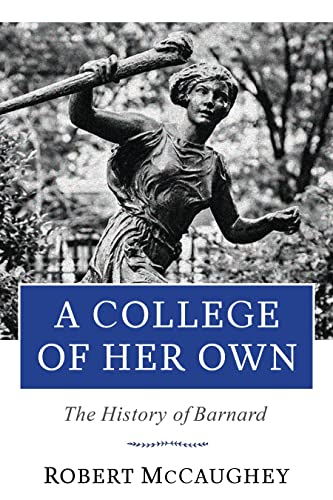
A college of her own : the history of Barnard / Robert McCaughey.
Material type: TextPublisher: New York : Columbia University Press, 2020Edition: First EditionDescription: xiv, 368 pages : illustrations ; 24 cmContent type:
 - text
- unmediated
- volume
- 9780231178006 (Cloth)
- 023117800X (Cloth)
- History of Barnard
- 378.747/1
- LD 7033 M478c 2020
| Item type | Current library | Home library | Collection | Shelving location | Call number | Copy number | Status | Barcode | |
|---|---|---|---|---|---|---|---|---|---|
 Libro
Libro
|
Biblioteca Juan Bosch | Biblioteca Juan Bosch | Humanidades | Humanidades (4to. Piso) | LD 7033 M478c 2020 (Browse shelf(Opens below)) | 1 | Available | 00000188050 |
Includes bibliographical references and index.
Preface Acknowledgements1. “What’s a New York Girl to Do?”2. East Side, West Side: A Tale of Two Cities3. Becoming Barnard4. Who’s Afraid of Virginia Gilderesleeve?5. Barnard in the Twenties6. Lean Times: Depression, War, and Other Distractions7. The McIntosh Era8. Into the Storm9. Saying No to Zeus10. Barnard Rising11. New York, New York12. Going GlobalNotesSelected BibliographyIndex
"In 1889, Annie Nathan Meyer, still in her early twenties, led the effort to start Barnard College after Columbia College refused to admit women. Named after a former Columbia president, Frederick Barnard, who had advocated for Columbia to become coeducational, Barnard, despite many ups and downs, became one of the leading women's colleges in the United States. A College of Her Own offers a comprehensive and lively narrative of Barnard from its beginnings to the present day. Through the stories of presidents and leading figures as well as students and faculty, Robert McCaughey recounts Barnard's history and how its development was shaped by its complicated relationship to Columbia University and its New York City location. McCaughey considers how the student composition of Barnard and its urban setting distinguished it from other Seven Sisters colleges, tracing debates around class, ethnicity, and admissions policies. Turning to the postwar era, A College of Her Own discusses how Barnard benefited from the boom in higher education after years of a precarious economic situation. Beyond the decisions made at the top, McCaughey examines the experience of Barnard students including the tumult and aftereffects of 1968 and the impact of the feminist movement. The concluding section looks at present-day Barnard, the shifts in its student body, and its efforts to be a global institution. Informed by McCaughey's five decades as a Barnard faculty member and administrator, A College of Her Own is a compelling history of a remarkable institution"-- Provided by publisher.
There are no comments on this title.