
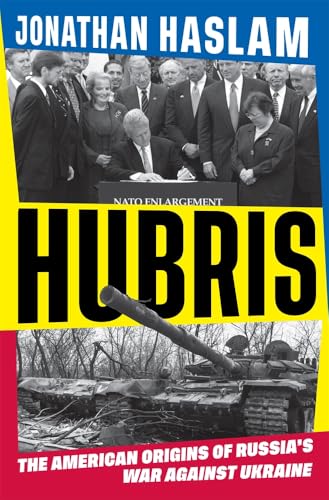
Hubris : the American origins of Russia's war against Ukraine / Jonathan Haslam.
Material type: TextLanguage: English Publisher: Cambridge, Massachusetts : The Belknap Press of Harvard University Press, 2025Edition: First Harvard University Press editionDescription: xviii, 350 pages : maps ; 25 cmContent type:
 - text
- unmediated
- volume
- 9780674299078 (hardcover)
- 0674299078 (hardcover)
- Guerra Ruso-Ucraniana, 2014- -- Causas
- Invasión rusa de Ucrania, 2022
- Guerra fría -- Influencia
- Ucrania -- Relaciones exteriores -- Rusia (Federación)
- Rusia (Federación) -- Relaciones exteriores -- Ucrania
- Ucrania -- Relaciones exteriores -- Estados Unidos
- Estados Unidos -- Relaciones exteriores -- Ucrania
- Rusia (Federación) -- Relaciones exteriores -- Estados Unidos
- Estados Unidos -- Relaciones exteriores -- Rusia (Federación)
- 342 DK 5417 H352h 2025
| Item type | Current library | Home library | Collection | Shelving location | Call number | Copy number | Status | Barcode | |
|---|---|---|---|---|---|---|---|---|---|
 Libro
Libro
|
Biblioteca Juan Bosch | Biblioteca Juan Bosch | Recursos Regionales | Recursos Regionales (2do. Piso) | 342 DK 5417 H352h 2025 (Browse shelf(Opens below)) | 1 | Available | 00000193475 |
Browsing Biblioteca Juan Bosch shelves, Shelving location: Recursos Regionales (2do. Piso), Collection: Recursos Regionales Close shelf browser (Hides shelf browser)
| No cover image available | No cover image available | No cover image available |

|

|

|

|
||
| 118 PQ 7409.2 L296e 2015 Espacios y resonancias / | 118 PQ 7409.2 L296e 2015 Espacios y resonancias / | 118 PQ 7409.2 L296e 2015 Espacios y resonancias / | 342 DK 5417 H352h 2025 Hubris : the American origins of Russia's war against Ukraine / | 002 E 181 A881 2003 Atlas of American military history / | 002 E 903 N817t 2017 The Time of Our Lives : politics, passions, and provocations / | 002 E 767 W754C 2024 Woodrow Wilson : the light withdrawn / |
"First published in the United Kingdom in 2024 as Hubris: The Origins of Russia's War against Ukraine by Head of Zeus, part of Bloomsbury Publishing Plc"--Title page verso.
Includes bibliographical references (pages 271-289) and index.
Part I. Pax Americana -- Russia elbowed out -- Western Europe caves in -- NATO goes to war -- Face to face with Putin -- Part II. Regime change -- Obama in office -- Maidan -- The road to Damascus -- Trump fails -- Paying the gas bill -- Conclusion: The war of the Russian Succession?
"A leading expert on US-Russian relations reveals how the United States and its European allies set the course for the war in Ukraine--and offers a sobering indictment of American foreign policy since the fall of the Soviet Union. Russia's full-scale invasion of Ukraine in February 2022 should not have taken the world by surprise. The attack escalated a war that began in 2014 with the Russian annexation of Crimea, but its origins are visible as far back as the aftermath of the Cold War, when newly independent Ukraine moved to the center of tense negotiations between Russia and the West. The United States was a leading player in this drama. In fact, Jonathan Haslam argues, it was decades of US foreign policy missteps and miscalculations, unchecked and often reinforced by European allies, that laid the groundwork for the current war. Isolated, impoverished, and relegated to a second-order power on the world stage, Russia grew increasingly resentful of Western triumphalism in the wake of the Cold War. The United States further provoked Russian ire with a campaign to expand NATO into Eastern Europe--especially Ukraine, the most geopolitically important of the former Soviet republics. Determined to extend its global dominance, the United States repeatedly ignored signs that antagonizing Russia would bring consequences. Meanwhile, convinced that Ukraine was passing into the Western sphere of influence, Putin prepared to shift the European balance of power in Russia's favor."-- Provided by publisher.
There are no comments on this title.