
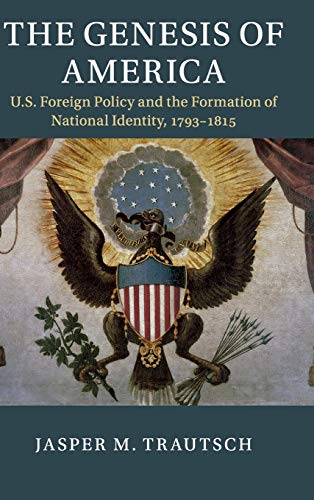
The genesis of America : U.S. foreign policy and the formation of national identity, 1793-1815 / Jasper M. Trautsch ; University of Regensburg, Germany.
Material type: TextLanguage: English Series: Cambridge studies in US foreign relations | Cambridge studies in US foreign relationsPublisher: [Cambridge, United Kingdom] ; New York, NY : Cambridge University Press, 2018Description: xiv, 314 pages : illustrations ; 24 cmContent type:
 - text
- unmediated
- volume
- 9781108428248 (hardback)
- 110842824X (hardback)
- 327.73009/033
- 002 E 310.7 T778g 2018
| Item type | Current library | Home library | Collection | Shelving location | Call number | Copy number | Status | Barcode | |
|---|---|---|---|---|---|---|---|---|---|
 Libro
Libro
|
Biblioteca Juan Bosch | Biblioteca Juan Bosch | Recursos Regionales | Recursos Regionales (2do. Piso) | 002 E 310.7 T778g 2018 (Browse shelf(Opens below)) | 1 | Available | 00000193679 |
Browsing Biblioteca Juan Bosch shelves, Shelving location: Recursos Regionales (2do. Piso), Collection: Recursos Regionales Close shelf browser (Hides shelf browser)

|

|

|

|

|

|

|
||
| 002 E 840.5 O58w 2022 The way forward : master life's toughest battles and create your lasting legacy master life's toughest battles and create your lasting legacy / | 322 DA 591 G619h 2016 Hammer of the left : the battle for the soul of the Labour Party / | 120 F 2235.3 B689Ar 2014 Bolívar : American liberator / | 002 E 310.7 T778g 2018 The genesis of America : U.S. foreign policy and the formation of national identity, 1793-1815 / | 002 E 185.61 B181n 2012 Notes of a native son / | 107 F 1788 F469 2012 Fifty years of revolution : perspectives on Cuba, the United States, and the world / | 107 HC 152.5 C962 2012 Cuban economic and social development : policy reforms and challenges in the 21st century / |
Includes bibliographical references (pages 270-303) and index.
Political Ideologies and American Identity in the Era of the French Revolution -- Foreign Policies of Unneutrality and the Jay Treaty -- Federalists and the Origins of the Quasi-War -- Disentangling America from France -- Republicans and the Origins of the War of 1812 -- Disentangling America from Great Britain.
Machine generated contents note: Introduction; 1. Political ideologies and American identity in the era of the French Revolution; 2. Foreign policies of unneutrality and the Jay Treaty; 3. Federalists and the origins of the Quasi-War; 4. Disentangling America from France; 5. Republicans and the origins of the War of 1812; 6. Disentangling America from Great Britain; Conclusion.
"The Genesis of America investigates the ways in which U.S. foreign policy contributed to the formation of an American national consciousness. Interpreting American nationalism as a process of external demarcation, Jasper M. Trautsch argues that, for a sense of national self to emerge, the U.S. needed to be disentangled from its most important European reference points: Great Britain and France. As he shows, foreign policy makers could therefore promote American nationalism by provoking foreign crises and wars with these countries, thereby creating external threats that would bind the fragile union together. By reconstructing how foreign policy was thus used as a nation-building instrument, Trautsch provides an answer to the puzzling question of how Americans - lacking a shared history and culture of their own and justifying their claim for independent nationhood by appeals to universal rights - could develop a sense of particularity after the conclusion of the Revolutionary War"-- Provided by publisher.
"On July 1, 1776, John Dickinson - a member of the Pennsylvania delegation to the Continental Congress - explained to the assembled convention why he was opposed to a declaration of independence. "To escape from the protection we have in British rule by declaring independence would be like Destroying a House before We have got another, In Winter, with a small Family," he told his colleagues. Before seeking separation from the mother country, "We should know on what Grounds We are to stand with Regard to one another," he suggested but found that "Some of Us totally despair of any reasonable Terms of Confederation." Dickinson therefore came to the conclusion that "PARTITION of these Colonies will take place if Great Britain cant conquer Us." Not only did the revolutionaries take the risk that they might lose the War of Independence against Great Britain; they also had to expect the union to fall apart if they were indeed successful, so Dickinson's argument went. Since no American collective sense of self had yet de- veloped, their attachment to Great Britain was all that tied colonists to each other. Once they severed the connection to the mother country, Americans, not yet having developed a national identity, would lack the foundation for maintaining their union"-- Provided by publisher.
There are no comments on this title.