
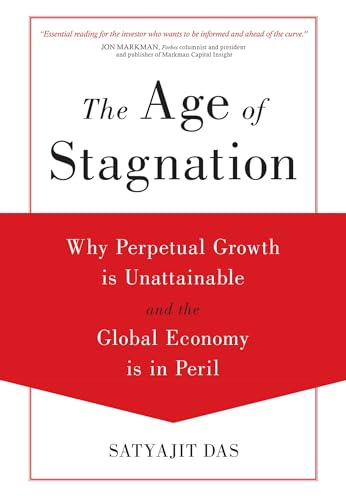
The age of stagnation : why perpetual growth is unattainable and the global economy is in peril / Satyajit Das.
Material type: TextLanguage: English Publisher: Amherst, NY : Prometheus Books, 2016Description: x, 337 pages ; 24 cmContent type:
 - text
- unmediated
- volume
- 9781633881587 (hardback)
- 163388158X (hardback)
- 330.9
- HD 82 D229a 2016
| Item type | Current library | Home library | Collection | Shelving location | Call number | Copy number | Status | Barcode | |
|---|---|---|---|---|---|---|---|---|---|
 Libro
Libro
|
Biblioteca Juan Bosch | Biblioteca Juan Bosch | Ciencias Sociales | Ciencias Sociales (3er. Piso) | HD 82 D229a 2016 (Browse shelf(Opens below)) | 1 | Available | 00000193713 |
Browsing Biblioteca Juan Bosch shelves, Shelving location: Ciencias Sociales (3er. Piso), Collection: Ciencias Sociales Close shelf browser (Hides shelf browser)

|
No cover image available |

|

|
No cover image available |

|

|
||
| HD 82 C737 1994 Comparative national development : society and economy in the new global order / | HD 82 C969f 2012 Foros camino a Cartagena / | HD 82 C996p 2004 The process of economic development / | HD 82 D229a 2016 The age of stagnation : why perpetual growth is unattainable and the global economy is in peril / | HD 82 D372e 1965 The economics of development in small countries, with special reference to the Caribbean / | HD 82 D441 2008 Desafíos actuales de la política económica : un enfoque estructural y social / | HD82 .D598 1979 Directions in economic development / |
Includes bibliographical references and index.
Prologue: Reality bites
Great expectations : postwar booms and busts
Borrowed times : causes of the global financial crisis and the Great Recession
Escape velocity : the power and impotence of economic policies
The end of growth : the factors driving secular stagnation and the new mediocre
Running on empty : the resource and environmental constraints on growth
Circling the wagons : globalization in reverse
BRIC(S) to BIITS : the rise and fall of emerging markets
Economic apartheid : the impact of rising inequality on growth
The end of trust : how a democracy deficit harms economic activity
Collateral damage : the fallout for ordinary lives
Epilogue : final orders
"The global economy is entering an era of protracted stagnation, similar to what Japan has experienced for over a decade. That is the message of this brilliant and controversial summary of our current economic predicament from an internationally respected consultant and commentator on financial markets, who predicted the Global Financial Crisis of 2008. The author challenges the assumption that growth can be perpetual and questions the ability of political leaders to enact the tough structural changes needed. He is particularly critical of the "easy money" approach to dealing with the great recession of 2008, citing the dangers of excessive debt and deep-seated fundamental imbalances. The fallout of these poor policies, he argues, will affect not only the business sector, but also the lifestyles and prosperity of average citizens and future generations. The author concludes with a thought experiment illustrating the large-scale changes that will be necessary to restore economic, financial, and social sustainability. This experiment has already been tried in Iceland, which went bankrupt in the wake of the 2008 crisis, and now, after a painful adjustment, is on the road to recovery. Written for the lay reader and peppered with witty anecdotes, this immensely readable book clearly explains the missteps that created the current dilemma, why a recovery has proved elusive, and the difficult remedies that must eventually be applied to ensure a stable future"-- Provided by publisher.
There are no comments on this title.