
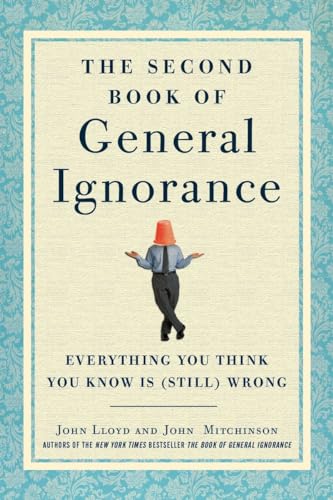
The second book of general ignorance : everything you think you know is (still) wrong / John Lloyd and John Mitchinson.
Material type: TextLanguage: English Publication details: New York : Crown, c2010.Edition: 1st U.S. edDescription: xvii, 330 pages : illustrations ; 22 cmContent type:
 - text
- unmediated
- volume
- 9780307951748
- 030795174X
- 9780307951762
- General ignorance
- 001.96
- BC 175 L793s 2010
| Item type | Current library | Home library | Collection | Shelving location | Call number | Copy number | Status | Barcode | |
|---|---|---|---|---|---|---|---|---|---|
 Libro
Libro
|
Biblioteca Juan Bosch | Biblioteca Juan Bosch | Recursos Regionales | Recursos Regionales (2do. Piso) | BC 175 L793s 2010 (Browse shelf(Opens below)) | 1 | Available | 00000193730 |
Includes index.
"Originally published in Great Britain by Faber and Faber Ltd., London, in 2010."--T.p. verso.
This sequel to the bestselling Book of General Ignorance continues the authors' mission of debunking commonly held myths and misconceptions in a witty, intelligent, and often hilarious way.
With the same QI-style humor (from the British panel show QI: Quite Interesting), this book challenges "obvious" facts and reveals how much of our so-called knowledge is actually wrong—or at least more complicated than we thought.
Each entry answers a seemingly simple question—about science, history, nature, language, or culture—and then explains why the most common answer is incorrect.
There are no comments on this title.