
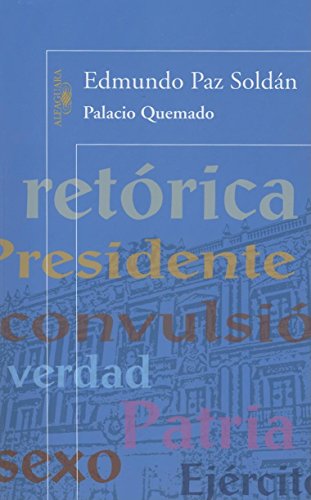
Palacio quemado/ Edmundo Paz Soldan
Material type: TextLanguage: Spanish Publication details: Florida : Alfaguara, 2006Description: 299 pages ; 24 cmISBN:
 - 9781598205466
- 1598205463
- P348p 2006
| Item type | Current library | Home library | Collection | Shelving location | Call number | Copy number | Status | Barcode | |
|---|---|---|---|---|---|---|---|---|---|
 Libro
Libro
|
Biblioteca Juan Bosch | Biblioteca Juan Bosch | Automatización y Procesos Técnicos | Automatización y Procesos Técnicos (1er. Piso) | P348p 2006 (Browse shelf(Opens below)) | 1 | Available | 00000195542 |
Browsing Biblioteca Juan Bosch shelves, Shelving location: Automatización y Procesos Técnicos (1er. Piso), Collection: Automatización y Procesos Técnicos Close shelf browser (Hides shelf browser)

|

|

|

|

|

|

|
||
| P335a 2011 Afrique(s) : du continent oublié au continent convoité / | P337l 2009 La literatura norteamericana y otros ensayos / | P342 2011 L'Europe au XXe siècle / | P348p 2006 Palacio quemado/ | P349r 1991 Rudimentos de logica matematica / | P358c 2010 Carnages : les guerres secráetes des grandes puissances en Afrique / | P361m 1995 Mystery & crime : the New York Public Library book of answers / |
Cuando Oscar era apenas un niño, su padre trabajaba en el Palacio presidencial. Fue en ese mismo Palacio que Felipe, su hermano mayor, decidió suicidarse. Treinta años después, Oscar vuelve al Palacio convertido en escritor de discursos del presidente, en un período de convulsión social, y trata de descubrir el por qué del suicidio de su hermano y buscar las palabras con las cuales apaciguar los ánimos exaltados del pueblo. Ésta es una novela sobre la perversa relación entre el poder y la violencia, sobre el peso (o no) de la palabra para transformar un país, y sobre la redención a través de la asunción de responsabilidades. ENGLISH DESCRIPTION Oscar was a child when his brother committed suicide in the Presidential Palace. Thirty years later, he returns as the official writer of Presidential speeches, in a time of social upheaval, trying to find a reason for his brother's suicide and the words to appease the people. Edmundo Paz Soldán's fast-paced narrative introduces us to the end of an era in the history of Bolivia, bringing to life the perverse connection between power and violence, the role (or lack of it) of the word in the transformation of a nation, and the redemption that occurs with the acceptance of responsibilities.
There are no comments on this title.