
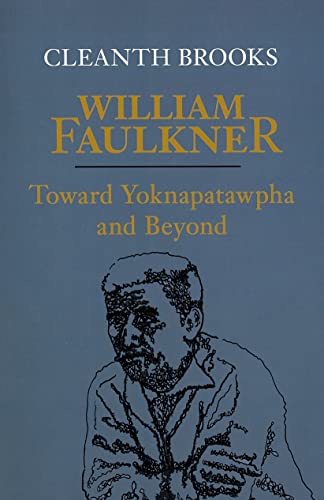
William Faulkner : toward Yoknapatawpha and beyond / Cleanth Brooks.
Material type: TextLanguage: English Publication details: Baton Rouge, La. : Louisiana State University Press, 1990, c1978.Description: xviii, 444 pages ; 22 cmContent type:
 - text
- unmediated
- volume
- 0807116025
- 9780807116029
- 813/.52 20
- PS3511.A86 B873w 1990
| Item type | Current library | Home library | Collection | Shelving location | Call number | Copy number | Status | Barcode | |
|---|---|---|---|---|---|---|---|---|---|
 Libro
Libro
|
Biblioteca Juan Bosch | Biblioteca Juan Bosch | Automatización y Procesos Técnicos | Automatización y Procesos Técnicos (1er. Piso) | PS3511.A86 B873w 1990 (Browse shelf(Opens below)) | 1 | Available | 00000198066 |
Reprint. Originally published: New Haven : Yale University Press, 1978.
Includes bibliographical references.
Contenidos : Faulkner’s Poetry
Early Romantic Prose
“A Payment Deferred” (Soldiers’ Pay)
Sketches, Early Stories, and an Abortive Novel
“A Fine Volley of Words” (Mosquitoes)
First Forays into Yoknapatawpha County
“People Without a Past” (Pylon)
“A Tale of Two Innocents” (The Wild Palms)
“Man’s Fate and Man’s Hope” (A Fable)
Faulkner on Time and History
Appendices, Notes, Index
This book is Cleanth Brooks’s companion volume to his earlier study William Faulkner: The Yoknapatawpha Country. While the earlier book focuses on Faulkner’s great novels set in the imaginary Yoknapatawpha County, Toward Yoknapatawpha and Beyond examines all the works that lie outside that central fictional universe — the early poetry, early prose, first novels, and later non-Yoknapatawpha books.
Brooks shows how Faulkner developed as a writer before discovering the narrative methods that would define his mature fiction. He traces the evolution from the young poet experimenting with romantic and symbolist modes, through the early novels (Soldiers’ Pay, Mosquitoes), to later novels that step beyond Yoknapatawpha (Pylon, The Wild Palms, A Fable). Throughout, Brooks highlights themes of time, history, human fate, and Faulkner’s deepening understanding of Southern identity.
The book’s broader argument is that Faulkner’s “minor” or lesser-read works are crucial to understanding the growth of his style and ideas. Even novels considered uneven or experimental reveal important steps toward the masterpieces. In its final chapters, the book reflects on Faulkner’s treatment of memory, historical consciousness, and narrative structure — elements that unify his entire body of work.
There are no comments on this title.