
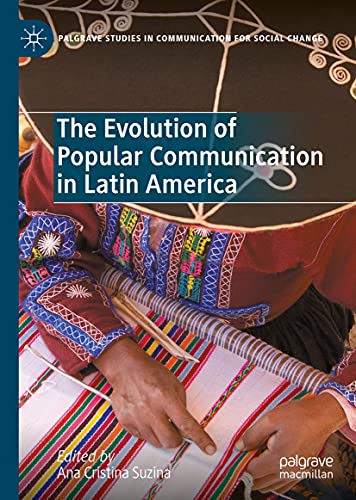
The evolution of popular communication in Latin America / Ana Cristina Suzina, editor
Material type: TextLanguage: English Series: Palgrave studies in communication for social changePublication details: Cham, Switzerland : Palgrave Macmillan, 2021Description: xv, 234 pages ; 22 cmISBN:
 - 9783030625566
- P 92 E93 2021
| Item type | Current library | Home library | Collection | Shelving location | Call number | Copy number | Status | Barcode | |
|---|---|---|---|---|---|---|---|---|---|
 Libro
Libro
|
Biblioteca Juan Bosch | Biblioteca Juan Bosch | Humanidades | Humanidades (4to. Piso) | P 92 E93 2021 (Browse shelf(Opens below)) | 1 | Available | 00000196998 |
1. Introduction: Popular Communication, an Epistemological Debate between South and North; Ana Cristina Suzina
Part I. The Roots of an Epistemology
2. Thinking about Communication from the Global South. Subjectivities Construction in Latin America: An Overview; Anibal Orue Pozzo
3. Popular and Communitarian Communication in Rural Social Movements: Beyond "Diffusionism" to Emancipatory Participation; Cicilia M. Krohling Peruzzo
4. Faith, Communication and Commitment to Liberation; Washington Uranga
5. The Vestiges of the Concept of Popular in Latin America; Santiago Gomez Obando
Part II. A Method, a Pedagogy, a Practice
6. Disenchantment as a Path Toward Autonomy: Orlando Fals Borda, Participatory Action Research, Communication and Social Change; Jair Vega-Casanova
7. A Praise of Dignity in Educational Practice; Daniel Prieto Castillo
8. Popular Radios: Constants and Tensions; Maria Cristina Mata
9. Popular Communication in Latin America: A Look at the Actors Who Build Bridges; Nivea Canalli Bona
Part III. Decolonial Perspectives
10. The Decolonial Nature of Comunicacao Popular; Leonardo Custodio
11. Digital Media and Emancipation in Latin American Communication Thinking; Dorismilda Flores-Marquez
12. Communication and Vivir Bien/Buen Vivir: In the Care of Our Common Home; Adalid Contreras Baspineiro
This book brings together twelve contributions that trace the empirical-conceptual evolution of Popular Communication, associating it mainly with the context of inequalities in Latin America and with the creative and collective appropriation of communication and knowledge technologies as a strategy of resistance and hope for marginalized social groups. In this way, even while emphasizing the Latin American and even ancestral identity of this current of thought, this book positions it as an epistemology of the South capable of inspiring relevant reflections in an increasingly unequal and mediatized world. The volumes contributors include both early-career and more established professionals and natives of seven countries in Latin America. Their contributions reflect on the epistemological roots of Popular Communication, and how those roots give rise to a research method, a pedagogy, and a practice, from decolonial perspectives.
There are no comments on this title.