
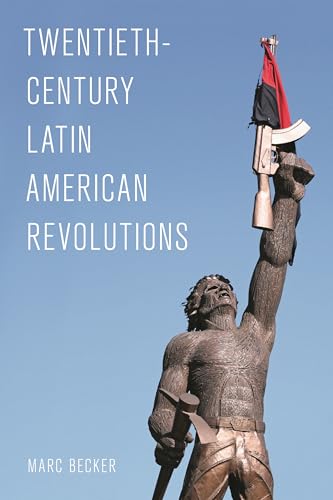
Twentieth-century Latin American revolutions / Marc Becker
Material type: TextLanguage: eng Publication details: Lanham : Rowman & Littlefield, 2017Description: viii, 261 páginas : ilustraciones ; 24 cmISBN:
 - 9781442265875
- B395 2017
| Item type | Current library | Home library | Collection | Shelving location | Call number | Copy number | Status | Barcode | |
|---|---|---|---|---|---|---|---|---|---|
 Libro
Libro
|
Biblioteca Juan Bosch | Biblioteca Juan Bosch | Automatización y Procesos Técnicos | Automatización y Procesos Técnicos (1er. Piso) | B395 2017 (Browse shelf(Opens below)) | 1 | Available | 00000197010 |
Browsing Biblioteca Juan Bosch shelves, Shelving location: Automatización y Procesos Técnicos (1er. Piso), Collection: Automatización y Procesos Técnicos Close shelf browser (Hides shelf browser)


Preface 1 Theories of Revolution Biography: José Carlos Mariátegui, 1894–1930 Document: José Carlos Mariátegui, “On the Indigenous Problem,” 1928 2 Mexican Revolution, 1910–1920 Biography: Emiliano Zapata, 1879–1919 Document: Emiliano Zapata, “Plan of Ayala,” 1911 3 Guatemalan Spring, 1944–1954 Biography: Jacobo Arbenz Guzmán, 1913–1971 Document: “Decree 900,” 1952 4 Bolivia’s Nationalist Revolution, 1952–1964 Biography: Juan Lechín Oquendo, 1914–2001 Document: The Union Federation of Bolivian Mine Workers (FSTMB),“Pulacayo Theses,” 1946 5 Cuban Revolution, 1959–Biography: Fidel Castro, 1926–2016 Document: “First Declaration of Havana,” 1960 6 Chilean Road to Socialism, 1970–1973 Biography: Salvador Allende Gossens, 1909–1973 Document: “Popular Unity Government: Basic Program,” 1970 7 Nicaraguan Sandinistas, 1979–1990 Biography: Carlos Fonseca Amador, 1936–1976 Document: “The Historic Program of the FSLN,” 1969 8 Guerrilla Warfare Biography: Che Guevara, 1928–1967 Document: Che Guevara, Guerrilla Warfare, 19609 Venezuela’s Bolivarian Revolution, 1999–Biography: Hugo Rafael Chávez Frías, 1954–2013 Document: Hugo Chávez, World Social Forum, 2005 10 Socialisms of the Twentieth and Twenty-First Centuries Glossary Index
Revolutions are a commonly studied but only vaguely understood historical phenomenon. This clear and concise text extends our understanding with a critical narrative analysis of key case studies: the 1910-1920 Mexican Revolution; the 1944-1954 Guatemalan Spring; the 1952-1964 MNR-led revolution in Bolivia; the Cuban Revolution that triumphed in 1959; the 1970-1973 Chilean path to socialism; the leftist Sandinistas in Nicaragua in power from 1979-1990; failed guerrilla movements in Colombia, El Salvador, and Peru; and the Bolivarian Revolution in Venezuela after Hugo Chávez's election in 1998. Marc Becker opens with a theoretical introduction to revolutionary movements, including a definition of what "revolution" means and an examination of factors necessary for a revolution to succeed. He analyzes revolutions through the lens of those who participated and explores the sociopolitical conditions that led to a revolutionary situation, the differing responses to those conditions, and the outcomes of those political changes. Each case study provides an interpretive explanation of the historical context in which each movement emerged, its main goals and achievements, its shortcomings, its outcome, and its legacy. The book concludes with an analysis of how elected leftist governments in the twenty-first century continue to struggle with issues that revolutionaries confronted throughout the twentieth century
There are no comments on this title.