
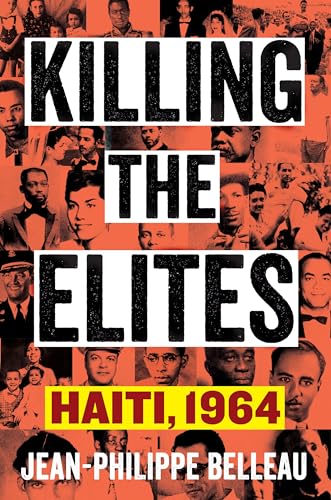
Killing the elites Haiti, 1964 / Jean-Philippe Belleau
Material type: TextLanguage: eng Publication details: New York : Columbia University Press, 2024Description: xvi, 362 pages : illustrations ; 23 cISBN:
 - 9780231213790
- B438 2024
| Item type | Current library | Home library | Collection | Shelving location | Call number | Copy number | Status | Barcode | |
|---|---|---|---|---|---|---|---|---|---|
 Libro
Libro
|
Biblioteca Juan Bosch | Biblioteca Juan Bosch | Automatización y Procesos Técnicos | Automatización y Procesos Técnicos (1er. Piso) | B438 2024 (Browse shelf(Opens below)) | 1 | Available | 00000197019 |
Part I. The Massacre. Chronology of the Massacre
Part II. Illegitimate Members of the Nation. Constructing the Enemy
Othering the Elite
A Pattern of Anti-Elite Massacres, 1812-1964
Part III. Murders among Persons. Jérémie's World
The Excelsior
Part IV. Duvalier's Evading Executioners. Kaponaj
The Military Commander
Bonds that Hold and Bonds to Break
Part V. The Relational Despot. The Ruler's Anxiety
Sociocentric Repression
In the summer of 1964, three extended families were exterminated in the coastal town of Jérémie, Haiti. All were from the local elite; one was the richest in town. The president of Haiti at the time, François 'Papa Doc' Duvalier, ordered the massacre while the military carried out the executions. It was a state crime; the civilian population played no role in it. However, this mass killing was soon constructed in oral history and the historiography as popular justice. The poor, entirely absent from the massacre, ended at the center of its apocryphal narrative. This event, known as the 'Jeremian Vespers,' occupies an important place in Haiti's oral history and historiography. At least 11 books mention it, although in no more than a few lines. It has never been the subject of a research and has been framed in sensationalist, counter-factual narratives. The unintelligibility and lack of clear causality of the massacre (why were families without any political activity killed by the regime?) elicited apocryphal explanations trying to rationalize a massacre that appeared irrational. Killing the Elites proposes a 'dive-in' ethnography that meticulously reconstitutes the various phases of the massacre, and identifies the victims, the various levels of responsibilities and perpetration, and the large spectrum of 'by-standing.' The study of this massacre is a pretext to explore three larger, overlooked topics: the François Duvalier regime (1957-1971); anti-elite sentiments and violence in Haiti since the mid-19th century; and the centrality of interpersonal relationships in the forms of, and resistance to, political violence. Belleau argues that Haiti's relational culture and a thick social fabric, untouched by the regime's barbarity, are key to understand ethical inhibitions and the complex mechanisms within Haitian culture that have prevented organized violence from spreading and degenerating into genocidal violence. This finding contradicts a sensationalist literature that depicts Haiti as a site of grotesque cruelty
There are no comments on this title.