
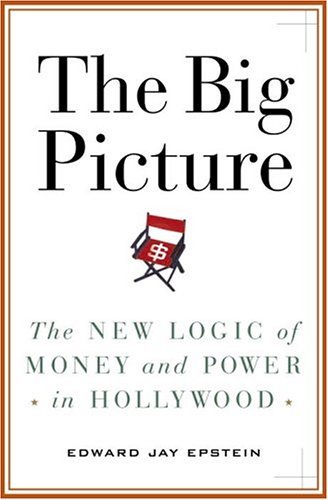
The big picture : money and power in Hollywood / Edward Jay Epstein
Material type: TextLanguage: eng Publication details: New York : Random House, 2005Description: x,396 Seiten : illustrations ; 24 cmISBN:
 - 9781400063536
- Ep64 2005
| Item type | Current library | Home library | Collection | Shelving location | Call number | Copy number | Status | Barcode | |
|---|---|---|---|---|---|---|---|---|---|
 Libro
Libro
|
Biblioteca Juan Bosch | Biblioteca Juan Bosch | Automatización y Procesos Técnicos | Automatización y Procesos Técnicos (1er. Piso) | Ep64 2005 (Browse shelf(Opens below)) | 1 | Available | 00000198963 |
During the heyday of the studio system spanning the 1930s, ‘40s, and ‘50s, virtually all the American motion picture industry’s money, power, and prestige came from a single activity: selling tickets at the box office. Today, the movie business is just a small, highly visible outpost in a media universe controlled by six corporations–Sony, Time Warner, NBC Universal, Viacom, Disney, and NewsCorporation. These conglomerates view films as part of an immense, synergistic, vertically integrated money-making industry.
In The Big Picture, acclaimed writer Edward Jay Epstein gives an unprecedented, sweeping, and thoroughly entertaining account of the real magic behind moviemaking: how the studios make their money. Epstein shows how, in Hollywood, the only art that matters is the art of the deal: major films turn huge profits, not from the movies themselves but through myriad other enterprises, such as video-game spin-offs, fast-food tie-ins, soundtracks, and even theme-park rides.
The studios may compete with one another for stars, publicity, box-office
receipts, and Oscars; their corporate parents, however, make fortunes
from cooperation (and collusion) with one another in less glamorous markets, such as cable, home video, and pay-TV.
But money is only part of the Hollywood story; the social and political milieus–power, prestige, and status–tell the rest. Alongside remarkable financial revelations, The Big Picture is filled with eye-opening true Hollywood insider stories. We learn how the promise of free cowboy boots for a producer delayed a major movie’s shooting schedule; why stars never perform their own stunts, despite what the supermarket tabloids claim; how movies intentionally shape political sensibilities, both in America and abroad; and why fifteen-year-olds dictate the kind of low-grade fare that has flooded screens across the country.
Epstein also offers incisive profiles of the pioneers, including Louis B. Mayer, who helped build Hollywood, and introduces us to the visionaries–Walt Disney, Akio Morita, Rupert Murdoch, Steve Ross, Sumner Redstone, David Sarnoff–power brokers who, by dint of innovation and deception, created and control the media that mold our lives. If you are interested in Hollywood today and the complex and fascinating way it has evolved in order to survive, you haven’t seen the big picture until you’ve read The Big Picture.
There are no comments on this title.