
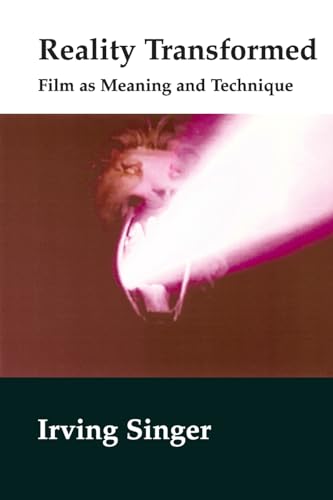
Reality transformed : film as meaning and technique / Irving Singer
Material type: TextLanguage: spa Publication details: Massachusetts : The MIT Press, Cambridge, 2000Description: xii, 216 pages : illustrations ; 23 cmISBN:
 - 9780262692489
- 0262692481
- Si617 2000
| Item type | Current library | Home library | Collection | Shelving location | Call number | Copy number | Status | Barcode | |
|---|---|---|---|---|---|---|---|---|---|
 Libro
Libro
|
Biblioteca Juan Bosch | Biblioteca Juan Bosch | Automatización y Procesos Técnicos | Automatización y Procesos Técnicos (1er. Piso) | Si617 2000 (Browse shelf(Opens below)) | 1 | Available | 00000198970 |
Browsing Biblioteca Juan Bosch shelves, Shelving location: Automatización y Procesos Técnicos (1er. Piso), Collection: Automatización y Procesos Técnicos Close shelf browser (Hides shelf browser)


For the last thirty years film theory has been dominated by "grand theories" that examine motion pictures from a psychoanalytic, semiotic, or Marxist point of view. Few American philosophers have written about the nature and aesthetics of cinema. In Reality Transformed Irving Singer offers a new approach to the philosophy of film. Returning to the classical debate between realists and formalists, he shows how the opposing positions may be harmonized and united. He accepts the realist claim that films somehow "capture" reality, but agrees with the formalist belief that they transform it. Extending his earlier work on meaning in art and life, he suggests that the meaningfulness of movies derives from techniques that re-create reality in the process of presenting it to viewers who have learned how to appreciate the aesthetics of cinematic transformation.
Singer concentrates on questions about appearance and reality, the visual and the literary, and the interplay between communication as a goal and alienation as a hazard in films of every sort. In three exemplary chapters, he provides suggestive readings of Woody Allen's The Purple Rose of Cairo, Luchino Visconti's Death in Venice, and Jean Renoir's The Rules of the Game. Reality Transformed will interest the general reader as well as students in all fields related to film studies.
There are no comments on this title.