
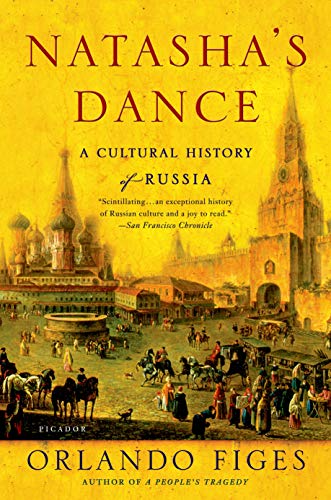
Natasha's dance : a cultural history of Russia / Orlando Figes.
Material type: TextLanguage: English Publication details: London : Picador, 2002.Description: xxxiii, 728 pages, 16 pages of plates : illustrations (some color), maps ; 25 cmISBN:
 - 9780312421953
- 0312421958
- 947
- F471n 2002
| Item type | Current library | Home library | Collection | Shelving location | Call number | Copy number | Status | Barcode | |
|---|---|---|---|---|---|---|---|---|---|
 Libro
Libro
|
Biblioteca Juan Bosch | Biblioteca Juan Bosch | Automatización y Procesos Técnicos | Automatización y Procesos Técnicos (1er. Piso) | F471n 2002 (Browse shelf(Opens below)) | 1 | Available | 00000183838 |
A history of Russia's mighty culture. It covers the lives of those who have shaped its culture, and the enduring spirit of a people.
Includes bibliographical references and index.
1. European Russia --
2. Children of 1812 --
3. Moscow! Moscow! --
4. The peasant marriage --
5. In search of the Russian soul --
6. Descendants of Genghiz Khan --
7. Russia through the Soviet lens --
8. Russia abroad.
History on a grand scale--an enchanting masterpiece that explores the making of one of the world's most vibrant civilizations A People's Tragedy, wrote Eric Hobsbawm, did "more to help us understand the Russian Revolution than any other book I know." Now, in Natasha's Dance, internationally renowned historian Orlando Figes does the same for Russian culture, summoning the myriad elements that formed a nation and held it together. Beginning in the eighteenth century with the building of St. Petersburg--a "window on the West"--and culminating with the challenges posed to Russian identity by the Soviet regime, Figes examines how writers, artists, and musicians grappled with the idea of Russia itself--its character, spiritual essence, and destiny. He skillfully interweaves the great works--by Dostoevsky, Stravinsky, and Chagall--with folk embroidery, peasant songs, religious icons, and all the customs of daily life, from food and drink to bathing habits to beliefs about the spirit world. Figes's characters range high and low: the revered Tolstoy, who left his deathbed to search for the Kingdom of God, as well as the serf girl Praskovya, who became Russian opera's first superstar and shocked society by becoming her owner's wife. Like the European-schooled countess Natasha performing an impromptu folk dance in Tolstoy's War and Peace, the spirit of "Russianness" is revealed by Figes as rich and uplifting, complex and contradictory--a powerful force that unified a vast country and proved more lasting than any Russian ruler or state.
There are no comments on this title.