
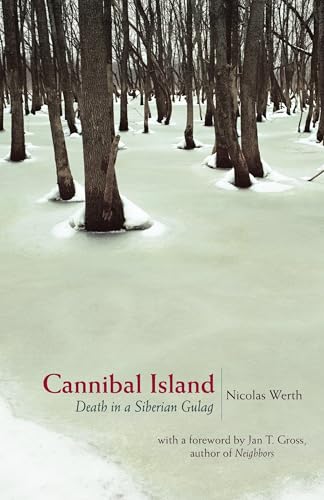
Cannibal Island : death in a Siberian Gulag / Nicholas Werth ; foreword by Jan T. Gross ; translated from the French by Steven Rendall.
Material type: TextLanguage: English Original language: French Series: Human rights and crimes against humanityPublication details: Princeton, N.J. : Princeton University Press, c2007.Description: xx, 223 p. ; 23 cmISBN:
 - 9780691130835 (cl. : alk. paper)
- 0691130833 (cl. : alk. paper)
- 338 DK 771 W499c 2007
| Item type | Current library | Home library | Collection | Shelving location | Call number | Vol info | Copy number | Status | Barcode | |
|---|---|---|---|---|---|---|---|---|---|---|
 Libro
Libro
|
Biblioteca Juan Bosch | Biblioteca Juan Bosch | Recursos Regionales | Recursos Regionales (2do. Piso) | 338 DK 771 W499c 2007 (Browse shelf(Opens below)) | 1 | 1 | Available | 00000069819 |
Browsing Biblioteca Juan Bosch shelves, Shelving location: Recursos Regionales (2do. Piso), Collection: Recursos Regionales Close shelf browser (Hides shelf browser)

|

|

|

|

|

|

|
||
| 338 DK 68.7 W749s 2004 Strategic partners : Russian-Chinese relations in the post-Soviet era / | 338 DK 69.3 D912s 1985 The Soviet Union and Cuba : interests and influence / | 338 DK 771 A781d 2008 Dersu Uzala / | 338 DK 771 W499c 2007 Cannibal Island : death in a Siberian Gulag / | 338 DK 857.75 M238f 2013 The fight for influence : Russia in Central Asia / | 338 DK 904 R632a 2008 Apples are from Kazakhstan : the land that disappeared / | 338 DK 908.867 N335n 2005 La nouvelle fracture internationale : aux sources du terrorisme / |
Includes bibliographical references.
Translated from the French.
"During the spring of 1933, Stalin's police rounded up nearly one hundred thousand people as part of the Soviet regimes "cleansing" of Moscow and Leningrad and deported them to Siberia. Many of the victims were sent to labor camps, but ten thousand of them were dumped in a remote wasteland and left to fend for themselves. Cannibal Island reveals the shocking, grisly truth about their fate." "These people were abandoned on the island of Nazino without food or shelter. Left there to starve and to die, they eventually began to eat each other. Nicolas Werth, a French historian of the Soviet era, reconstructs their gruesome final days using rare archival material from deep inside the Stalinist vaults. Werth weaves this episode into a broader story about the Soviet frenzy in the 1930s to purge society of all those deemed to be unfit. For Stalin, these undesirables included criminals, opponents of forced collectivization, vagabonds, gypsies, even entire groups in Soviet society such as the "kulaks" and their families. Werth sets his story within the broader social and political context of the period, giving us for the first time a full picture of how Stalin's system of "special villages" worked, how hundreds of thousands of Soviet citizens were moved about the country in wholesale mass transportations, and how this savage bureaucratic machinery functioned on the local, regional, and state levels." "Cannibal Island challenges us to confront unpleasant facts not only about Stalin's punitive social controls and his failed Soviet utopia, but about every generation's capacity for brutality - including our own."--BOOK JACKET.
There are no comments on this title.