
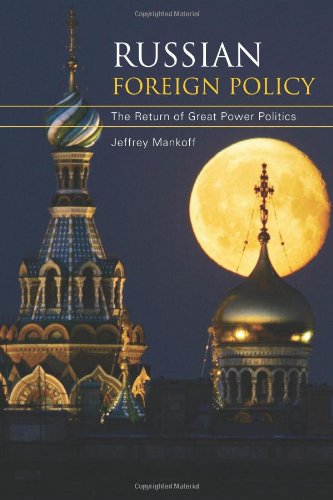
Russian foreign policy : the return of great power politics / Jeffrey Mankoff.
Material type: TextLanguage: Eng Publication details: Lanham, Md. : Rowman & Littlefield, c2009.Description: xii, 359 p. ; 23 cmISBN:
 - 9780742557949 (cloth : alk. paper)
- 0742557944 (cloth : alk. paper)
- 9780742557956 (pbk. : alk. paper)
- 0742557952 (pbk. : alk. paper)
- 9780742557963 (electronic)
- 0742557960 (electronic)
- 327.47
- 338 JZ 1616 M278r 2009
| Item type | Current library | Home library | Collection | Shelving location | Call number | Vol info | Copy number | Status | Barcode | |
|---|---|---|---|---|---|---|---|---|---|---|
 Libro
Libro
|
Biblioteca Juan Bosch | Biblioteca Juan Bosch | Recursos Regionales | Recursos Regionales (2do. Piso) | 338 JZ 1616 M278r 2009 (Browse shelf(Opens below)) | 1 | 1 | Available | 00000111866 |
Includes bibliographical references (p. 313-371) and index.
This text examines development of Russian foreign policy since end of the Cold War. Jeffrey Mankoff argues that Russia's more assertive behavior since Vladimir Putin became president in 2000 has resulted from both a consensus among its elite about Russia's identity and interests and a favorable convergence of events, including persistence of high energy prices and the check on U.S. power resulting from wars in Iraq and Afghanistan. Because these factors are result of long-term trends, Mankoff argues there is little reason to expect election of Dmitry Medvedev will fundamentally alter Russian foreign policy behavior. Presenting controversial issues, he analyzes Russia's interactions with major global actors, including United States, European Union, the Commonwealth of Independent States, and China. Despite Moscow's often-harsh rhetoric and deployment of Russian forces against Georgia in 2008, the author demonstrates that there is little reason to fear a return to a Cold War-like standoff with the West. Instead, he argues, today's Russia is more interested in restoring what its leaders consider to be its rightful place among the world's major powers rather than in directly challenging the West--Publisher's description.
Contours of Russian foreign policy -- Bulldogs fighting under the rug : the making of Russian foreign policy -- Partnership imperiled : Russia and the United States -- Europe : between integration and confrontation -- Rising China and Russia's Asian vector -- Back on the offensive? : the former Soviet Union -- Dealing with Russia's foreign policy reawakening.
There are no comments on this title.