
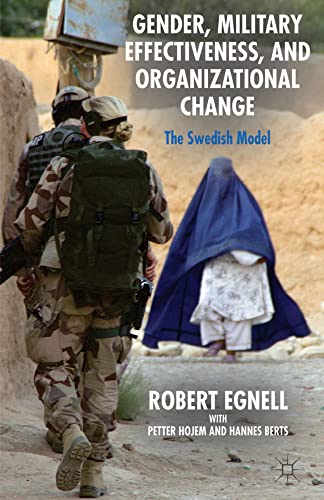
Gender, military effectiveness, and organizational change : the Swedish model / Robert Egnell, Visiting Professor and Director of Teaching, Center for Security Studies, Georgetown University, USA; Petter Hojem, Project Leader, Centre for Business and Policvy Studies, SNS, Sweden; and Hannes Berts, Founding Partner and Senior Consultant, Sthlm Policy Group AB, Sweden.
Material type: TextPublisher: Houndmills, Basingstoke, Hampshire ; New York, NY : Palgrave Macmillan, 2014Description: xi, 185 pages ; 23 cmContent type:
 - text
- unmediated
- volume
- 9781137385048 (hardback)
- Sweden -- Armed Forces -- Women
- Suecia -- Fuerzas Armadas -- Mujeres
- Women soldiers -- Sweden
- Mujeres soldados -- Suecia
- Organizational change -- Sweden
- United Nations. Security Council. Resolution 1325
- POLITICAL SCIENCE / International Relations / General
- POLITICAL SCIENCE / Public Policy / Social Policy
- POLITICAL SCIENCE / Globalization
- POLITICAL SCIENCE / Political Freedom & Security / General
- POLITICAL SCIENCE / Government / International
- 355.0082/09485
- 340 UB 419 E31g 2014
- POL011000 | POL029000 | POL033000 | POL035000 | POL040020
| Item type | Current library | Home library | Collection | Shelving location | Call number | Vol info | Copy number | Status | Barcode | |
|---|---|---|---|---|---|---|---|---|---|---|
 Libro
Libro
|
Biblioteca Juan Bosch | Biblioteca Juan Bosch | Recursos Regionales | Recursos Regionales (2do. Piso) | 340 UB 419 E31g 2014 (Browse shelf(Opens below)) | 1 | 1 | Available | 00000111454 |
Browsing Biblioteca Juan Bosch shelves, Shelving location: Recursos Regionales (2do. Piso), Collection: Recursos Regionales Close shelf browser (Hides shelf browser)

|

|

|

|

|

|
No cover image available | ||
| 340 DL 719 C933A 2009 La Reina Cristina de Suecia / | 340 DL 876 P172M 2009 Pero quién mató a Olof Palme? : primera biografia en clave hispana del líder sueco asesinado / | 340 JS 6263 S974 1996 Swedish local government : traditions and reforms / | 340 UB 419 E31g 2014 Gender, military effectiveness, and organizational change : the Swedish model / | 341 BR 410 G662s 2002 The Swiss Reformation / | 341 DL 860 M623c 1995 Civil society and state relations in sweden / | 341 DQ 17 B344a 1968 All about Switzerland : a short survey / |
"In October 2000, the United Nations Security Council passed Resolution 1325 which reaffirmed the important role of women in the prevention and resolution of conflicts as well as in post-conflict reconstruction. Since the resolution was passed, the Swedish Armed Forces have gone through an impressive process of change that has set the agenda for instituting Resolution 1325 in militaries throughout the world. What began as a project of limited scope within the Swedish armed forces has steadily evolved to mainstream a gender perspective, conduct training, and to establish specific gender-related functions and institutions such as Gender Field Advisors, Gender Focal Points and the Nordic Centre for Gender in Military Operations. Through extensive interviews and analyses of internal documents, this study provides a unique understanding of these organizational processes, the driving factors and the roadblocks within the armed forces, as well as the impact of a gender perspective in the field of operations. This insight, and the resulting lessons learned, is not only essential for the continued process of implementation in the Swedish case, but also for similar processes in the armed forces and other security related organizations around the world. "-- Provided by publisher.
Includes bibliographical references (pages 165-173) and index.
Machine generated contents note: -- 1. Introduction: The Accomplishments and the Challenges -- 2. Gender, Feminism, and Military Effectiveness -- 3. Changing the Armed Forces -- 4. A Gender Perspective in the Field of Operations -- 5. Recruitment, Harassment, and Equal Rights: The Rights-based Processes -- 6. Evaluating the Process and Impact of Change -- 7. Conclusion: Improving and Spreading the Implementation.
There are no comments on this title.