
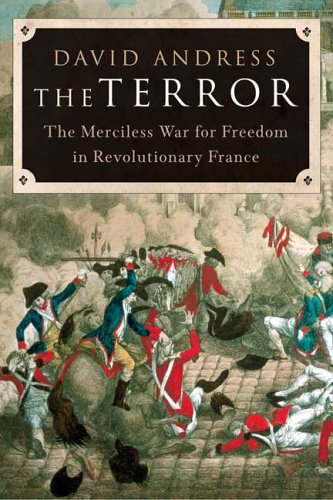
The Terror : the merciless war for freedom in revolutionary France / David Andress.
Material type: TextPublication details: New York : Farrar, Straus, and Giroux, 2006.Edition: 1st American edDescription: 441 p. : ill., maps ; 24 cmISBN:
 - 0374273413 (alk. paper)
- 9780374273415 (alk. paper)
- 944.04/4 22
- DC183.5 A561t 2006
- 15.70
| Item type | Current library | Home library | Collection | Shelving location | Call number | Vol info | Copy number | Status | Barcode | |
|---|---|---|---|---|---|---|---|---|---|---|
 Libro
Libro
|
Biblioteca Juan Bosch | Biblioteca Juan Bosch | Recursos Regionales | Recursos Regionales (2do. Piso) | DC183.5 A561t 2006 (Browse shelf(Opens below)) | 3 | 1 | Available | 00000053767 |
Browsing Biblioteca Juan Bosch shelves, Shelving location: Recursos Regionales (2do. Piso), Collection: Recursos Regionales Close shelf browser (Hides shelf browser)

|

|
No cover image available |

|

|

|

|
||
| DC158.8 F911p 2002 Political actors : representative bodies and theatricality in the age of the French Revolution / | DC160 .O79n 1992 Une Nation pour mémoire : 1889, 1939, 1989, trois jubilés révolutionnaires / | DC179 .L217 1851-52 Historia de los girondinos, | DC183.5 A561t 2006 The Terror : the merciless war for freedom in revolutionary France / | DC203 C4551990 The illustrated Napoleon / | DC 203 N216R 2014 Napoleon : a life / | DC203 .N38 2002 Napoleon / |
Includes bibliographical references (p. 403-427) and index.
Night flight -- Hankering after destruction -- The fall -- The September massacres -- Dawn of a new age -- Things fall apart -- Holding the centre -- Saturnalia -- Faction and conspiracy -- Glaciation -- Triumph and collapse -- Terror against terror.
For two hundred years, the Terror has haunted the imagination of the West. The descent of the French Revolution from rapturous liberation into an orgy of apparently pointless bloodletting has been the focus of countless reflections on the often malignant nature of humanity and the folly of revolution. David Andress, a leading historian of the French Revolution, presents a radically different account of the Terror. The violence, he shows, was a result of dogmatic and fundamentalist thinking: dreadful decisions were made by groups of people who believed they were still fighting for freedom but whose survival was threatened by famine, external war, and counter-revolutionaries within the fledgling new state. Urgent questions emerge from Andress's reassessment: When is it right to arbitrarily detain those suspected of subversion? When does an earnest patriotism become the rationale for slaughter? This new interpretation draws troubling parallels with today's political an religious fundamentalism.--From publisher description.
There are no comments on this title.