
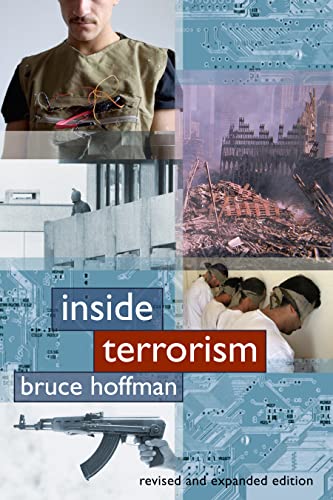
Inside terrorism / Bruce Hoffman.
Material type: TextPublication details: New York : Columbia University Press, c2006.Edition: Rev. and expanded edDescription: xvii, 432 p., [20] p. of plates : ill. ; 23 cmISBN:
 - 0231126980 (cloth : alk. paper)
- 9780231126984 (cloth : alk. paper)
- 0231126999 (pbk. : alk. paper)
- 9780231126991 (pbk. : alk. paper)
- 0231510462 (electronic)
- 9780231510462 (electronic)
- 363.325 22
- H699i 2006
| Item type | Current library | Home library | Collection | Shelving location | Call number | Vol info | Copy number | Status | Barcode | |
|---|---|---|---|---|---|---|---|---|---|---|
 Libro
Libro
|
Biblioteca Juan Bosch | Biblioteca Juan Bosch | Ciencias Sociales | Ciencias Sociales (3er. Piso) | H699i 2006 (Browse shelf(Opens below)) | 3 | 1 | Available | 00000056880 |
Browsing Biblioteca Juan Bosch shelves, Shelving location: Ciencias Sociales (3er. Piso), Collection: Ciencias Sociales Close shelf browser (Hides shelf browser)


Includes bibliographical references (p. [369]-413) and index.
Preface to the revised and expanded edition -- Preface to the first edition -- Chapter 1. Defining terrorism -- Chapter 2. The end of empire and the origins of contemporary terrorism -- Chapter 3. The internationalization of terrorism -- Chapter 4. Religion and terrorism -- Chapter 5. Suicide terrorism -- Chapter 6. The old media, terrorism, and public opinion -- Chapter 7. The new media, terrorism, and the shaping of global opinion -- Chapter 8. The modern terrorist mind-set : tactics, targets, tradecraft, and technologies -- Chapter 9. Terrorism today and tomorrow -- Notes -- Bibliography -- Index.
In this revised edition, the author analyzes the new adversaries, motivations, and tactics of global terrorism that have emerged in recent years, focusing specifically on how Al Qaeda has changed since 9/11; the reasons behind its resiliency, resonance, and longevity; and its successful use of the Internet and videotapes to build public support and gain new recruits. He broadens the discussion by evaluating the potential repercussions of the Iraqi insurgency, the use of suicide bombers, terrorist exploitation of new communications media, and the likelihood of a chemical, biological, radiological, or nuclear terrorist strike. Looking at the U.S., he reconsiders the Timothy McVeigh case and the threats posed by American Christian white supremacists and abortion opponents as well as those posed by militant environmentalists and animal rights activists. He argues that the attacks on the World Trade Center fundamentally transformed the West's view of the terrorist threat.
There are no comments on this title.