
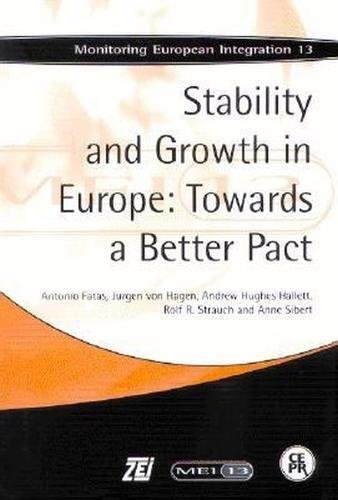
Stability and growth in Europe : towards a better pact / Antonio Fatás ... [et al.]
Material type: TextLanguage: English Series: Monitoring European integration ; 13Publication details: London : Centre for Economic Policy Research, 2003.Description: xvi, 89 p. : ill. ; 25 cmISBN:
 - 1898128774
- 337.142
- HJ 1000 S775 2003
| Item type | Current library | Home library | Collection | Shelving location | Call number | Vol info | Copy number | Status | Barcode | |
|---|---|---|---|---|---|---|---|---|---|---|
 Libro
Libro
|
Biblioteca Juan Bosch | Biblioteca Juan Bosch | Ciencias Sociales | Ciencias Sociales (3er. Piso) | HJ 1000 S775 2003 (Browse shelf(Opens below)) | 1 | 1 | Available | 00000122851 |
Includes bibliographical references (p. 83-89)
The fiscal policy framework of the EMU is in a states of crisis. Since the start of EMU, fiscal conditions in some member states have slipped considerably beyond the limits set by the Maastricht Treaty and the Stability and Growth Pact. It is clear that the preventive arm of the Stability and Growth Pact has failed to preclude excessive deficits. There is no shortage of proposals to reform the current fiscal framework in this crisis situation. They range from calls for softening their implementation, and to proposals for closer coordination of national fiscal policies. None of these proposals offers a convincing solution to the problem at the heart of the current crisis: how to balance the need for effective long-run fiscal stability in EMU with the need for short-run flexibility of fiscal policy in the member states. After a detailed analysis of the virtues and defects of the current fiscal framework, this report presents a proposal for reform that addresses this issue. The authors argue that EMU should move away from rigid fiscal rules for annual deficits towards a more judgmental process of monitoring the sustainability of fiscal policies. This approach is guided by three principles: independence, transparency, and legitimacy. Together wit the ability to assess the fiscal situation and outlook of each euro-area member state, they are the keys to designing a framework that provides enough flexibility and, at the same time, can build the required credibility and political support. The authors propose the creation of a Sustainability Council for the EMU, and independent body with the sole statutory task of safeguarding the sustainability of public finances in the euro area. The Sustainability Council regularly and openly reports to the public and the European Parliament its assessment of the member states’ fiscal policies, taking into account past performance, current perspectives and the future course of fiscal policies. Its mandate is the counterpart of the ECB’s principal task of maintaining price stability. However, the Sustainability Council has no operative role in fiscal policy; it relies solely on the pressure of informed public opinion to discipline national governments. The use of the instruments of fiscal policy is entirely left to the national governments, and the Sustainability Council can only be conceived as a judge of national public finances.
There are no comments on this title.