
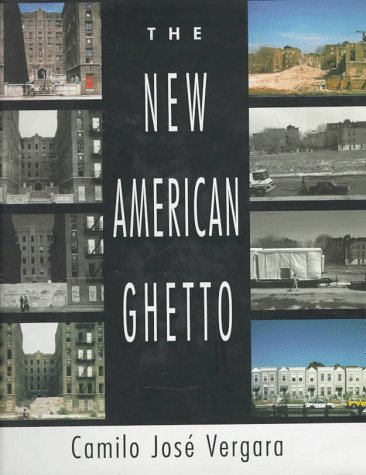
The new American ghetto / Camilo José Vergara.
Material type: TextLanguage: Spanish Publication details: New Brunswick, N.J. : Rutgers University Press, c1995.Description: xvii, 235 p. : ill. (some col.) ; 29 cmISBN:
 - 0813522099 (alk. paper)
- 307.3/362 20
- HN 57 V494n 1995
| Item type | Current library | Home library | Collection | Shelving location | Call number | Copy number | Status | Barcode | |
|---|---|---|---|---|---|---|---|---|---|
 Libro
Libro
|
Biblioteca Juan Bosch | Biblioteca Juan Bosch | Ciencias Sociales | Ciencias Sociales (3er. Piso) | HN 57 V494n 1995 (Browse shelf(Opens below)) | 1 | Available | 00000098913 |
Browsing Biblioteca Juan Bosch shelves, Shelving location: Ciencias Sociales (3er. Piso), Collection: Ciencias Sociales Close shelf browser (Hides shelf browser)
| No cover image available |

|
No cover image available |

|

|
No cover image available |

|
||
| HN 57 R289 1969 Rebelión en Estados Unidos : antología documental / | HN57 R961a 2010 A renegade history of the United States / | HN 57 S678 1999 The social fabric / | HN 57 V494n 1995 The new American ghetto / | HN 57 Y75d 2015 Dissent : the history of an American idea / | HN 58 Ni Marx ni Jésus : de la segunda revolución americana a la segunda revolución mundial / | HN 58 N346w 2004 What's wrong with America? : how the rich and powerful have changed America and now want to change the world / |
Includes bibliographical references (p. 231-235).
Introduction --
The ghetto cityscape --
Housing --
Commerce and industry --
Our fortified ghettos --
We are here --
The impact of addictions and homelessness --
Ghettos transformed --
Conclusion: no solution in sight.
The New American Ghetto provides an exploration, over nearly two decades, of ghettos in New York, Newark, Los Angeles, Chicago, Detroit, and smaller cities. Camilo Jose Vergara chronicles, through photographs and text, the profound transformations experienced by these places since the riots of the 1960s. He provides direct observations of urban landscapes and interiors, from residential areas and institutions to vacant lots and abandoned factories. He takes successive photographs of the same places, tracking change over time - changes that have made the conditions of today's ghettos very different from those of an earlier era. Vergara's interviews with residents and historical research contribute to his unique view of the nature and meaning of the inner city. Termed "a photographic forecast of the demise of urban America," The New American Ghetto brings to light a world of forgotten ruin and struggling reconstruction.
There are no comments on this title.