
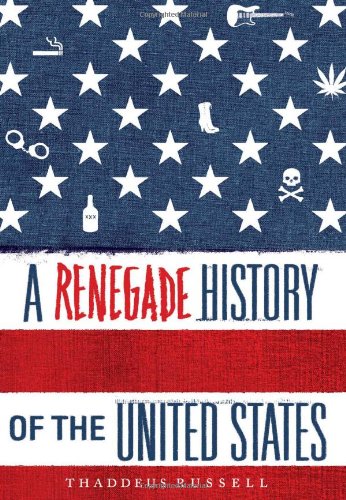
A renegade history of the United States / Thaddeus Russell.
Material type: TextPublication details: New York : Free Press, 2010.Edition: 1st Free Press hardcover edDescription: xiii, 382 p. ; 24 cmISBN:
 - 9781416571063
- 141657106X
- 303.48/4086930973 22
- HN57 R961a 2010
| Item type | Current library | Home library | Collection | Shelving location | Call number | Vol info | Copy number | Status | Barcode | |
|---|---|---|---|---|---|---|---|---|---|---|
 Libro
Libro
|
Biblioteca Juan Bosch | Biblioteca Juan Bosch | Ciencias Sociales | Ciencias Sociales (3er. Piso) | HN57 R961a 2010 (Browse shelf(Opens below)) | 3 | 1 | Available | 00000094685 |
Browsing Biblioteca Juan Bosch shelves, Shelving location: Ciencias Sociales (3er. Piso), Collection: Ciencias Sociales Close shelf browser (Hides shelf browser)

|

|
No cover image available |

|
No cover image available |

|

|
||
| HN 57 P228s 2003 The soft cage : surveillance in America, from slavery to the war on terror / | HN57 .Q44 2001 Balsamic dreams : a short but self-important history of the baby boomer generation / | HN 57 R289 1969 Rebelión en Estados Unidos : antología documental / | HN57 R961a 2010 A renegade history of the United States / | HN 57 S678 1999 The social fabric / | HN 57 V494n 1995 The new American ghetto / | HN 57 Y75d 2015 Dissent : the history of an American idea / |
Includes bibliographical references (p. 345-361) and index.
Introduction -- Part 1: Making Renegades Into Americans -- 1: Drunkards, laggards, prostitutes, pirates, and other heroes of the American revolution -- 2: Freedom of slavery -- 3: Slavery of freedom -- 4: Whores and the origins of women's liberation -- Part 2: How White People Lost Their Rhythm -- 5: Rhythmless nation -- 6: From white chimps to Yankee doodles: the Irish -- 7: Jew was a Negro -- 8: Italian-Americans: out of Africa -- Part 3: Fighting For Bad Freedom -- 9: Shopping: the real American revolution -- 10: How gangsters made America a better place -- 11: Behold a dictator: fascism and the New Deal -- 12: Just how popular was World War II? -- Part 4: Which Side Are You On? -- 13: How juvenile delinquents won the Cold War -- 14: Process of self-purification: the civil rights movement's attack on African-Americans -- 15: Gay liberation, American liberation -- 16: Almost free: the promise and tragedy of rednecks and hippies -- Acknowledgment -- Sources -- Permissions -- Index.
From the Publisher: In this groundbreaking book, noted historian Thaddeus Russell tells a new and surprising story about the origins of American freedom. Rather than crediting the standard textbook icons, Russell demonstrates that it was those on the fringes of society whose subversive lifestyles helped legitimize the taboo and made America the land of the free. In vivid portraits of renegades and their "respectable" adversaries, Russell shows that the nation's history has been driven by clashes between those interested in preserving social order and those more interested in pursuing their own desires - insiders versus outsiders, good citizens versus bad. The more these accidental revolutionaries existed, resisted, and persevered, the more receptive society became to change. Russell brilliantly and vibrantly argues that it was history's iconoclasts who established many of our most cherished liberties. Russell finds these pioneers of personal freedom in the places that usually go unexamined - saloons and speakeasies, brothels and gambling halls, and even behind the Iron Curtain. He introduces a fascinating array of antiheroes: drunken workers who created the weekend; prostitutes who set the precedent for women's liberation, including "Diamond Jessie" Hayman, a madam who owned her own land, used her own guns, provided her employees with clothes on the cutting-edge of fashion, and gave food and shelter to the thousands left homeless by the 1906 San Francisco earthquake; there are also the criminals who pioneered racial integration, unassimilated immigrants who gave us birth control, and brazen homosexuals who broke open America's sexual culture. Among Russell's most controversial points is his argument that the enemies of the renegade freedoms we now hold dear are the very heroes of our history books - he not only takes on traditional idols like John Adams, Thomas Jefferson, Andrew Carnegie, John Rockefeller, Thomas Edison, Franklin Roosevelt, and John F. Kennedy, but he also shows that some of the most famous and revered abolitionists, progressive activists, and leaders of the feminist, civil rights, and gay rights movements worked to suppress the vibrant energies of working-class women, immigrants, African Americans, and the drag queens who founded Gay Liberation. This is not history that can be found in textbooks - it is a highly original and provocative portrayal of the American past as it has never been written before.
There are no comments on this title.