
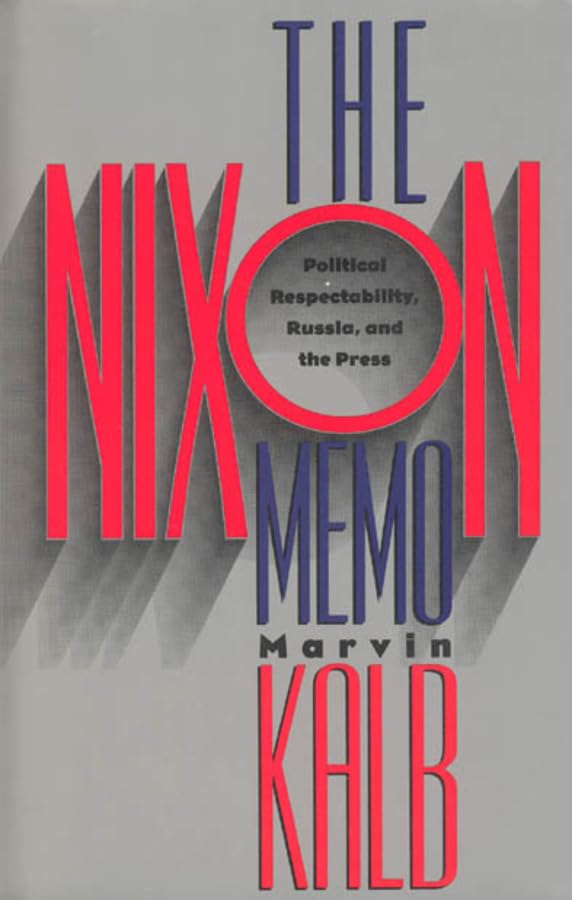
The Nixon memo : political respectability, Russia, and the press / Marvin Kalb.
Material type: TextLanguage: English Publication details: Chicago : University of Chicago Press, 1994Description: x, 248 pages ; 22 cmISBN:
 - 0226422992 (cloth : alk. paper)
- 9780226422992 (cloth : alk. paper)
- Nixon, Richard M. (Richard Milhous), 1913-1994
- Nixon, Richard M. (Richard Milhous), 1913-1994
- Press and politics -- United States
- Prensa y política -- Estados Unidos
- Presidents -- United States -- Election -- 1992
- Presidentes -- Estados Unidos -- Elecciones -- 1992
- United States -- Foreign relations -- Soviet Union
- Estados Unidos -- Relaciones exteriores
- Soviet Union -- Foreign relations -- United States
- Estados Unidos -- Política y gobierno -- 1969-1974
- Estados Unidos -- Historia -- 1972-1974
- 973.924/092
- 002 E 856 K14n 1994
| Item type | Current library | Home library | Collection | Shelving location | Call number | Copy number | Status | Barcode | |
|---|---|---|---|---|---|---|---|---|---|
 Libro
Libro
|
Biblioteca Juan Bosch | Biblioteca Juan Bosch | Recursos Regionales | Recursos Regionales (2do. Piso) | 002 E 856 K14n 1994 (Browse shelf(Opens below)) | 1 | Available | 00000007119 |
Browsing Biblioteca Juan Bosch shelves, Shelving location: Recursos Regionales (2do. Piso), Collection: Recursos Regionales Close shelf browser (Hides shelf browser)

|

|

|

|

|

|
No cover image available | ||
| 002 E 856 S741p 1984 Presidents and the press : the Nixon legacy / | 002 E 856 F312p 2010 Poisoning the press : Richard Nixon, Jack Anderson, and the rise of Washington's scandal culture / | 002 E 856 G795n 2003 Nixon's shadow : the history of an image / | 002 E 856 K14n 1994 The Nixon memo : political respectability, Russia, and the press / | 002 E 856 N736e 1990 En la arena / | 002 E 856 N736i 1990 In the arena : A memoir of victory, defeat, and renewal / | 002 E 856 N736r 1979 RN : the memoirs of Richard Nixon. |
Includes bibliographical references (p. [225]-227) and index.
Machine derived contents note: Table of contents for The Nixon memo : political respectability, Russia, and the press / Marvin Kalb
Bibliographic record and links to related information available from the Library of Congress catalog
Information from electronic data provided by the publisher. May be incomplete or contain other coding
Acknowledgments
1. The Idea
2. "I'm One of the Most Hated"
3. "To Give History a Nudge"
4. Bingo!
5. "Who Lost Russia?"
6. Enter the Press
7. The Conference: First, Nixon
8. The Conference: and Then Bush
9. "The Tide Turning"
10. The Ultimate Irony
11. Shadow Minister
12. The Final Nixon
Epilogue: Memories of Watergate
Appendix: The Nixon Memo (March 1992)
How to Lose the Cold War
Bibliography
Index
Library of Congress subject headings for this publication: Nixon, Richard M, (Richard Milhous), 1913- Views on Russia, Press and politics United States, United States Foreign relations Russia, Russia Foreign relations United States, Presidents United States Election 1992
An absorbing example of political journalism, The Nixon Memo is the story of Richard Nixon's relentless quest for political rehabilitation. At issue is the key role he played during his final years in the post-Cold War debate about aiding Russia in its uncertain revolution. A thousand ironies and insights emerge in this book: Nixon, who made his reputation crusading against communism, argues that support for Russia is the most important foreign policy issue facing the United States. Nixon, who in the early 1950s raised the politically devastating question "Who lost China?" holds the question "Who lost Russia?" over Bill Clinton's fortunes in the early nineties. Nixon, who mistrusted and despised the press, turns to the press and particularly the op-ed page of the nation's most influential newspaper as a vehicle for influencing public opinion. This story of Nixon's Machiavellian efforts to pressure the White House, by way of the press, into helping Boris Yeltsin and Russia sheds new light on the inner workings of the world inside the Washington beltway. Though Nixon is the central character in this story, other politicians will easily recognize the everyday characteristics of governance, and news people will also recognize the important issue of what makes a story "news." Marvin Kalb read the documents behind the Nixon memo and interviewed scores of journalists, scholars, and officials in Washington and Moscow. Drawing on his years of experience as a diplomatic correspondent, he powerfully illuminates the intersection of press and politics in the fashioning of public policy
There are no comments on this title.