
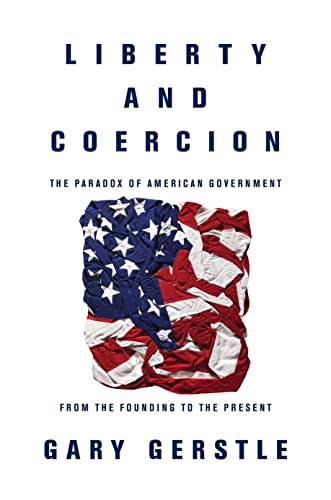
Liberty and coercion : the paradox of American government from the founding to the present / Gary Gerstle.
Material type: TextLanguage: English Publication details: Princeton : Princeton University Press, 2015.Description: xiii, 452 pages ; 25 cmISBN:
 - 9780691162942 (hardcover : alk. paper)
- 0691162948 (hardcover : alk. paper)
- Federal government -- United States -- History
- Federal-state controversies -- United States -- History
- Abuse of administrative power -- United States -- History
- Political culture -- United States -- History
- Gobierno federal -- Estados Unidos
- Controversias federales-estatales
- Exceso de poder (Derecho administrativo) -- Estados Unidos
- Cultura política -- Estados Unidos
- United States -- Politics and government
- Estados Unidos -- Política y gobierno
- 320.473/049
- JK 311 G383l 2015
| Item type | Current library | Home library | Collection | Shelving location | Call number | Copy number | Status | Barcode | |
|---|---|---|---|---|---|---|---|---|---|
 Libro
Libro
|
Biblioteca Juan Bosch | Biblioteca Juan Bosch | Ciencias Sociales | Ciencias Sociales (3er. Piso) | JK 311 G383l 2015 (Browse shelf(Opens below)) | 1 | Available | 00000121953 |
Browsing Biblioteca Juan Bosch shelves, Shelving location: Ciencias Sociales (3er. Piso), Collection: Ciencias Sociales Close shelf browser (Hides shelf browser)

|
No cover image available | No cover image available |

|

|

|

|
||
| JK305 A3518.2007 | JK 305 A182n2007 La nueva división de poderes / | JK 305 C359p 1964 Power in Washington; a critical look at today's struggle to govern in the Nation's Capital / | JK 305 C359p 1965 El poder y los grupos de presion / | JK 311 G383l 2015 Liberty and coercion : the paradox of American government from the founding to the present / | JK 311 G383l 2017 Libertad y coacción : la paradoja del gobierno estadunidense desde su fundación hasta el presente / | JK 311 K43d 2020 The divided states of America : why federalism doesn't work / | JK 311 L864r 2002 Relaciones intergubernamentales en los estados autonómico y federal : estudio sobre los Estados Unidos, el Estado español y el País Vasco / |
Includes bibliographical references and index.
A liberal state emerges, 1780-1840 -- The states and their police power, 1790s-1920s -- An improvisational liberal state, 1860-1920 -- World War I : crisis and resurgence -- Money, parties, and extra-constitutional government, 1830-1930 -- From populism to the iron triangle : building the agricultural state, 1880-1940 -- From Gilded Age strikes to the treaty of Detroit : the challenge of labor, 1880-1960 -- Leviathan rising, 1945-1970 -- Breaking the power of the states, 1960-1980 -- Leviathan besieged, 1980-2015.
American governance is burdened by a paradox. On the one hand, Americans don't want 'big government' meddling in their lives; on the other hand, they have repeatedly enlisted governmental help to impose their views regarding marriage, abortion, religion, and schooling on their neighbors. These contradictory stances on the role of public power have paralyzed policymaking and generated rancorous disputes about government's legitimate scope. How did we reach this political impasse? Historian Gary Gerstle, looking at two hundred years of U.S. history, argues that the roots of the current crisis lie in two contrasting theories of power that the Framers inscribed in the Constitution. One theory shaped the federal government, setting limits on its power in order to protect personal liberty. Another theory molded the states, authorizing them to go to extraordinary lengths, even to the point of violating individual rights, to advance the 'good and welfare of the commonwealth.' The Framers believed these theories could coexist comfortably, but conflict between the two has largely defined American history. Gerstle shows how national political leaders improvised brilliantly to stretch the power of the federal government beyond where it was meant to go--but at the cost of giving private interests and state governments too much sway over public policy. The states could be innovative, too. More impressive was their staying power. Only in the 1960s did the federal government, impelled by the Cold War and civil rights movement, definitively assert its primacy. But as the power of the central state expanded, its constitutional authority did not keep pace. Conservatives rebelled, making the battle over government's proper dominion the defining issue of our time. From the Revolution to the Tea Party, and the Bill of Rights to the national security state, Liberty and Coercion is a revelatory account of the making and unmaking of government in America.
There are no comments on this title.