
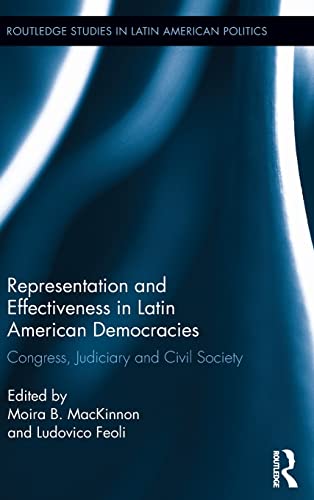
Representation and effectiveness in Latin American democracies : congress, judiciary and civil society / edited by Moira B. MacKinnon and Ludovico Feoli.
Material type: TextSeries: Routledge studies in Latin American politicsPublication details: New York : Routledge, 2013.Description: xvii, 312 p. ; 24 cmISBN:
 - 9780415824330 (hardback)
- Representative government and representation -- Latin America -- Case studies
- Legislative bodies -- Latin America -- Case studies
- Courts -- Latin America -- Case studies
- Civil society -- Latin America -- Case studies
- Gobierno representativo -- América Latina
- América Latina -- Política y gobierno
- 20150900
- 328.8/0734
- JL 963 R425 2013
| Item type | Current library | Home library | Collection | Shelving location | Call number | Vol info | Copy number | Status | Barcode | |
|---|---|---|---|---|---|---|---|---|---|---|
 Libro
Libro
|
Biblioteca Juan Bosch | Biblioteca Juan Bosch | Ciencias Sociales | Ciencias Sociales (3er. Piso) | JL 963 R425 2013 (Browse shelf(Opens below)) | 1 | 1 | Available | 00000113763 |
Browsing Biblioteca Juan Bosch shelves, Shelving location: Ciencias Sociales (3er. Piso), Collection: Ciencias Sociales Close shelf browser (Hides shelf browser)


Includes bibliographical references and index.
p.1. Introduction -- p.2. Congress -- p.3. Judiciary -- p.4. Civil society -- p.5. Conclusion.
"Legislatures, the judiciary and civil society are important actors in representative democracies. In what ways and how well do they represent? And how effectively do they carry out their institutional and social roles? Both questions refer to the key dimensions of democracy analyzed in this book: representativeness and effectiveness, respectively. While they have been developed separately in scholarly work on institutions and regimes, there is little work considering them simultaneously, and on their interaction. Using quantitative and/or qualitative methods, contributions from top scholars in the field of legislatures, the judiciary and civil society examine these two concepts and their relationships in four Latin American countries: Argentina, Brazil, Chile, and Mexico. Designed to guide the reader through the complexities of this debate, each expert engages in a larger set of theoretical debates about different approaches to representation in each sphere. In doing so, they debate how effectively these spheres carry out their roles in each country: whether a congress is institutionalized, its accountability, and its performance as a lawmaker; whether a judicial system is independent, carries out oversight, and protects citizen rights; and the role of civil society in a representative democracy. Representation and Effectiveness in Latin American Democracies is a timely and welcomed contribution to the to the growing debate about the quality of democracy in Latin America, and the developing world more generally"-- Provided by publisher.
There are no comments on this title.