
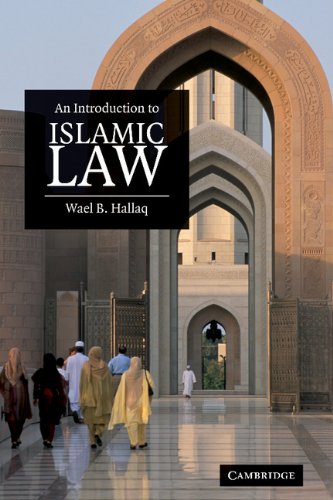
An introduction to Islamic law / Wael B. Hallaq.
Material type: TextPublication details: Cambridge ; New York : Cambridge University Press, 2011.Description: vii, 200 p. ; 24 cmISBN:
 - 9780521861465 (hbk.)
- 0521861462 (hbk.)
- 9780521678735 (pbk.)
- 0521678730 (pbk.)
- 340.59
- KBP 144 H182i 2009
- 86.14
| Item type | Current library | Home library | Collection | Shelving location | Call number | Vol info | Copy number | Status | Barcode | |
|---|---|---|---|---|---|---|---|---|---|---|
 Libro
Libro
|
Biblioteca Juan Bosch | Biblioteca Juan Bosch | Ciencias Sociales | Ciencias Sociales (3er. Piso) | KBP 144 H182i 2009 (Browse shelf(Opens below)) | 1 | 1 | Available | 00000108901 |
Browsing Biblioteca Juan Bosch shelves, Shelving location: Ciencias Sociales (3er. Piso), Collection: Ciencias Sociales Close shelf browser (Hides shelf browser)
| No cover image available |

|

|

|

|

|

|
||
| K 7683 C778 2001 Cooperación jurídica internacional / | KBL .A925 1996 On Schacht's origins of Muhammadan jurisprudence / | KBP 144 A531t 1996 Toward an Islamic reformation : civil liberties, human rights, and international law / | KBP 144 H182i 2009 An introduction to Islamic law / | KBP 144 I82 2004 Islamic law and the challenges of modernity / | KBP 144 M962i 2002 Islamic law : theory and interpretation / | KBP 470 R165i 2008 Islam, la réforme radicale : ethique et libération / |
Includes bibliographical references (p. 184-191) and index.
pt.1. Tradition and continuity -- pt. 2. Modernity and ruptures.
The study of Islamic law can be a forbidding prospect for those entering the field for the first time. Wael Hallaq, a leading scholar and practitioner of Islamic law, guides students through the intricacies of the subject in this absorbing introduction. The first half of the book is devoted to a discussion of Islamic law in its pre-modern natural habitat. The author expounds on the roles of jurists, who reasoned about the law, and of judges and others who administered justice; on how different legal schools came to be established, and on how a moral law functioned in early Muslim society generally. The second part explains how the law was transformed and ultimately dismantled during the colonial period. As the author demostrates, this rupture necessitated its reinvention in the twentieth-century world nation-states. In the final chapters, the authors charts recent developments and the strggles of the Islamists to negotiate changes which have seen the law emerge as a primarily textual enity focused on fixed punishments and ritual requirements. The book, which includes a chronology, a glossary of key terms, and lists for further reading, will be the first stop for those who wish to understand the fundamentals of Islamic law, its practices and history.
There are no comments on this title.