
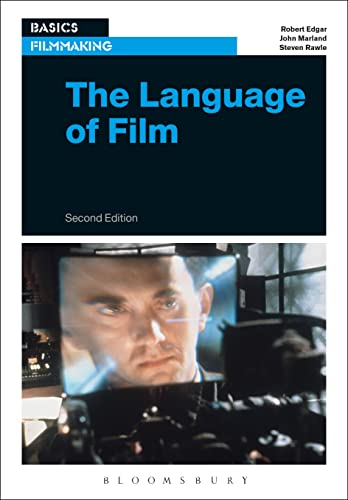
The language of film / Robert Edgar, John Marland, Steven Rawle.
Material type: TextPublisher: London ; New York : Fairchild Books, an imprint of Bloomsbury Publishing PLC, [2015]Edition: 2nd edDescription: 216 pages : illustrations (chiefly color) ; 23 cmISBN:
 - 9781472575241 (paperback)
- 791.43014
- PN 1995 E23l 2015
| Item type | Current library | Home library | Collection | Shelving location | Call number | Vol info | Copy number | Status | Barcode | |
|---|---|---|---|---|---|---|---|---|---|---|
 Libro
Libro
|
Biblioteca Juan Bosch | Biblioteca Juan Bosch | Humanidades | Humanidades (4to. Piso) | PN 1995 E23l 2015 (Browse shelf(Opens below)) | 1 | 1 | Available | 00000114869 |
Browsing Biblioteca Juan Bosch shelves, Shelving location: Humanidades (4to. Piso), Collection: Humanidades Close shelf browser (Hides shelf browser)

|

|

|

|

|

|

|
||
| PN 1995 D348c 2017 Cine. I, Bergson y las imágenes / | PN 1995 D861v 2015 La valeur d'un film : philosophie du beau au cinéma / | PN 1995 E16r 2013 Roger Ebert's movie yearbook 2013 / | PN 1995 E23l 2015 The language of film / | PN 1995 E34c 1978 Cineliteracy : film among the arts / | PN 1995 E36f 1943 The film sense / | PN 1995 E36f 1949 The film form : essays in film / |
"First published in 2010."
"Becoming an effective filmmaker involves being deliberately mindful of the structures and conventions that allow film to communicate meaning to a global audience. The Language of Film explores complex topics such as semiotics, narrative, intertextuality, ideology and the aesthetics of film in a clear and straightforward style, enabling you to apply these ideas and techniques to your own analysis or film-making. With full-colour film stills, in-depth case studies and a wide range of practical exercises, The Language of Film will help you to make the transition from consumer to practitioner - from someone who just responds to the language of film, to someone who actively uses it. In the second edition, a new chapter examines how sound contributes to narrative and space to tell stories, create imaginary worlds and shape the realist (and often non-realist) effect of cinema. Along with two case studies from the first edition, Seven (dir: David Fincher) and Citizen Kane (dir: Orson Welles), the second edition also includes five new case studies: The Secret Life of Walter Mitty (dir: Ben Stiller), Dead Man's Shoes (dir: Shane Meadows), Hero (dir: Yimou Zhang), Berberian Sound Studio (d: Peter Strickland) and Psycho (d: Alfred Hitchcock)"-- Provided by publisher.
Includes bibliographical references and index.
Machine generated contents note: -- Introduction -- Chapter 1 - Semiotics: Images; The Visual Mind; Reading the Signs; Making Meaning; Codes and Filters; Case study: Seven (d: David Fincher, US); Chapter 1 Summary. Chapter 2 - Narrative: Theories of Storytelling; Structuralism; Theories of Structure; Genette's Narrative Discourse; Case Study: The Secret Life of Walter Mitty (dir: Ben Stiller); Chapter 2 Summary. Chapter 3 - Intertextuality: Text; Quotation; Allusion; Cult Film; Genre; Case Study: Citizen Kane (dir: Orson Welles); Chapter 3 Summary. Chapter 4 - Ideology: Ideological Analysis; Realism; Ideology and Genre; Case study: Dead Man's Shoes (dir: Shane Meadows); Chapter 4 Summary. Chapter 5 - Frames and Images: The Shot; Distance, Height and Framing; Mise en Scene; The Mobile Camera Frame; Time and the Long Take; Case Study: Hero (dir: Yimou Zhang); Chapter 5 Summary.Chapter 6 - Sound: Film: An Audio-visual Medium; Sound Properties; Diegetic and Non-diegetic Sound; Off-screen Space and Audio; The voice; Music; Case study: Berberian Sound Studio (dir: David Strickland); Chapter 6 Summary.Chapter 7 - Constructing Meaning: Continuity Editing; Discontinuity Editing; Montage; Pacing; Space; Case study: Psycho (dir: Alfred Hitchcock); Chapter 7 Summary.Conclusion.
There are no comments on this title.