
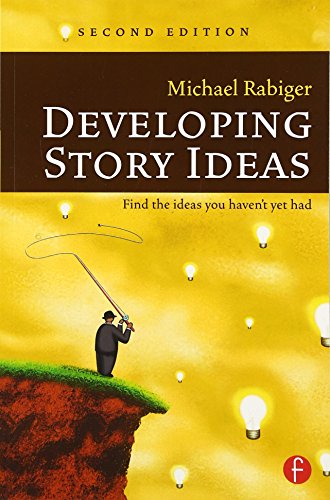
Developing story ideas / Michael Rabiger.
Material type: TextPublication details: Burlington, MA : Focal Press, c2006.Edition: 2nd edDescription: xi, 241 p. : ill. ; 23 cmISBN:
 - 9780240807362 (pbk. : alk. paper)
- 0240807367 (pbk. : alk. paper)
- 808.2/3 22
- PN1996 R116 2006
| Item type | Current library | Home library | Collection | Shelving location | Call number | Vol info | Copy number | Status | Barcode | |
|---|---|---|---|---|---|---|---|---|---|---|
 Libro
Libro
|
Biblioteca Juan Bosch | Biblioteca Juan Bosch | Humanidades | Humanidades (4to. Piso) | PN1996 R116 2006 (Browse shelf(Opens below)) | 4 | 1 | Available | 00000111100 |
Includes bibliographical references and index.
Part I: Overview: This book, its goals and getting started. -- You and the creative process -- -- Part II: Self- examination, observation, and improvisation assignments: Artistic identity. -- Introductions and playing CLOSAT. -- Autobiography and influences. -- Observing from life. -- -- Part III: Using the tools of drama: Developing your characters and the dramatist's toolkit. -- Analyzing a scene. -- Assessing a complete work. -- Testing a story idea and deciding point of view. -- -- Part IV: Creative writing assignments: A tale from childhood. -- Family story. -- A myth, legend, or folktale retold. -- Dream story. -- Adapting a short story. -- Ten-minute, news-inspired story. -- A documentary subject. -- Thirty-minute original fiction. -- Feature film. -- -- Part V: The emerging writer: Revisiting your artistic identity. -- -- Part VI: Expanding your work into its final form: Story-editing your outline. -- Expanding your outline.
The vast majority of screenplay and writing books focus on story development and have little to say about the initial concept that generated the piece. Developing Story Ideas offers writers a spectrum of resources and a structure of writing practice so that anyone can quickly and reliably generate a wide variety of stories in a broad range of forms. It first shows you how to observe situations, acts, and themes-and use these observations as the basis for storytelling. Exercises and projects help you draw an artistic self-profile to summarize what you most need to investigate in your creative work. Micahel Rabiger, a renowned teacher, author, educator, and mentor, proves we all have the inner resources and life experiences to be creative. He guides aspiring writers step by step to come up with quality story ideas in a broad range of forms: a screenplay, short story, documentary, or play."--Publisher's website.
There are no comments on this title.